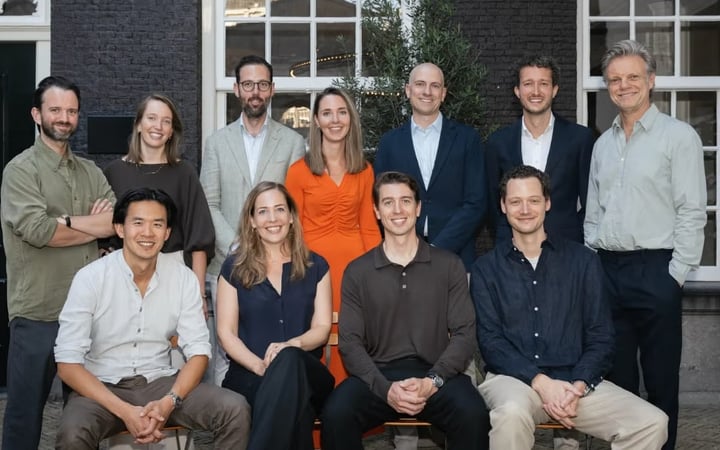
Avendar wins pitch competition at HumanX conference in Amsterdam
·3 min read
Den Bosch startup Avendar has won the pitch competition at HumanX, a three-day AI conference held in Amsterdam last week. Co-founder and CEO Marijn van Aerle beat a field of hundreds of applicants: first as one of 25 selected companies in the semi-final, then as one of six finalists, and ultimately as the winner.
Avendar, founded in 2025 and headquartered in 's-Hertogenbosch, is developing an AI platform for risk decisions at police and justice organisations. The company targets European government agencies operating in high-risk environments, combining AI models with human expertise to support professionals in complex decision-making.
HumanX brings together founders, investors and other AI professionals. Van Aerle used the stage to explain the platform and its underlying approach to an audience with both technical and business backgrounds.
What Avendar is building
The platform operates around two core components. The first, Public Intelligence, collects and analyses reports from the public and helps police investigators automatically prioritise that information. The second component, Undermining, screens subsidy applications for patterns that may indicate corruption or abuse, using automated data analysis.
Both functions are aimed at situations where large volumes of information must be processed quickly and accurately, and where an incorrect decision can have serious consequences. Avendar explicitly states its commitment to explainable AI outcomes, so that professionals can follow the reasoning behind a recommendation and retain ultimate responsibility themselves.
Nathan Okkerse, a project lead at a police service working with the platform, states in a testimonial on Avendar's website that the system streamlines the management of reports and improves the accuracy of investigations. Avendar lists his title as Project Lead for Online Investigative Communications, but does not specify which service he works for.
The company holds ISO 27001 certification and states that it complies with the EU AI Act and the GDPR. Data sovereignty within the Netherlands is an explicit principle: infrastructure and data remain under Dutch control, which may be a requirement for government agencies when procuring this type of system.
Funding and recent milestones
In May 2026, Avendar raised €2.2 million in an early funding round. The company also announced earlier this year that it had won the Gerard & Anton Philips Award 2026, a distinction linked to the Brabant tech and entrepreneurship scene. In early July, Avendar and the Jheronimus Academy of Data Science (JADS) in 's-Hertogenbosch announced a bootcamp focused on AI-driven investigations, aimed specifically at public sector professionals.
The combination of the pitch win in Amsterdam, the earlier funding round and the collaboration with JADS paints a picture of a young company that has rapidly built visibility in both the technology and public sector markets. Avendar has only existed since 2025 and has accumulated multiple external recognitions in a relatively short period of time.
Position in the European public AI market
The market for AI applications at government agencies is attracting growing attention across Europe, both from a technology perspective and from a regulatory one. The EU AI Act classifies systems deployed in law enforcement and risk assessment as high-risk, meaning that suppliers must meet strict transparency and accountability requirements. Avendar positions itself as a European alternative built to meet those requirements from the outset, rather than adapting foreign systems after the fact.
For other Dutch and European AI companies targeting the public sector, the emergence of Avendar demonstrates that there is room for specialised platforms that treat compliance as a starting point rather than an afterthought. Investors looking at GovTech and public safety applications may regard the combination of early customer relationships, external recognition and a clear geopolitical positioning as a relevant signal.
Graduate Ventures has launched a second seed fund with a target size of €125 million, of which €100 million has already been committed. The fund focuses exclusively on founders from Dutch universities in AI, deep tech, healthcare and climate.
Meta's Superintelligence Lab launched Muse Wonder and Muse Wonder Full, the company's first frontier models, on 12 October 2026. Access via the Meta Model API costs $4 per million input tokens and $20 per million output tokens, the same rate as Claude Opus 5.5.
Delft-based deeptech company Perciv AI closed a €2.5 million seed round in December 2024, led by Day One Capital Ventures and Keen Venture Partners, with participation from Vinci Venture Capital. The company develops radar-based perception software for autonomous systems in automotive, robotics and aviation.