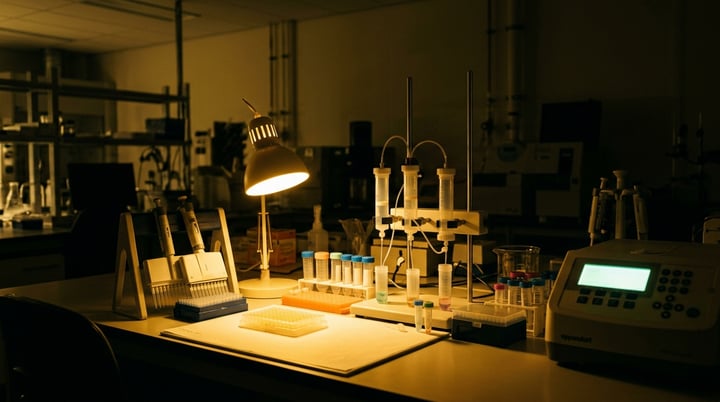
Designing proteins has traditionally taken years: trial and error in the lab, endless iterations, and results that more often disappoint than deliver. Amsterdam-based Cradle is working on an approach in which a computational platform and an in-house wet lab continuously complement each other. The company focuses on proteins for both therapeutic applications, such as medicines, and industrial purposes, such as enzymes for sustainable production processes.
Cradle was founded in 2021 by a team with backgrounds in machine learning, bio-engineering and product development. CEO Stef van Grieken describes the goal concisely: helping scientists design better proteins faster, from therapeutics to sustainable materials, by combining AI and laboratory validation, achieving a speed-up of one-and-a-half to twelve times compared with conventional methods. In January 2024, the company raised one hundred million euros in a Series B round.
How the platform works
The core of Cradle's approach is the combination of two components that remain separate in many comparable companies: an ML platform that generates and selects candidate proteins, and an in-house wet lab that tests those candidates directly. The results of those lab experiments feed back into the models, making them sharper. This creates a closed loop of predicting, testing and refining.
On the ML side, co-founder and ML researcher Eli Bixby, who previously worked on optimisation techniques at Google, works on so-called multi-round batch optimization. This means the system does not make a single proposal, but delivers progressively better protein sequences across multiple rounds, even when little experimental data is available. This is relevant because only a handful of data points may exist for many specific proteins.
The lab component is led by Harmen van Rossum, who heads the bio-engineering team. That team generates large datasets that feed the platform, and works closely with the ML researchers to evaluate models. Properties such as binding affinity or thermal stability, how well a protein binds to its target or how well it withstands heat, are measurable and therefore usable as training signals for the models.
A team with diverse backgrounds
The founding group has been deliberately assembled from people across different disciplines. Elise de Reus, who is responsible for partnerships, holds a PhD from the Technical University of Denmark and has a background in fungal synthetic biology. She connects the team's scientific expertise to external collaborations with partners in the pharmaceutical and industrial sectors.
Jelle Prins brings a very different background: he previously designed apps for Uber, Booking.com and Catawiki. At Cradle, he focuses on the user experience of the platform, ensuring that scientists can work with it without extensive ML knowledge. This is a deliberate choice: if the platform is only accessible to specialists, the potential user base remains limited.
This breadth of the team, spanning ML engineering, synthetic biology and product development, reflects the nature of the problem Cradle is addressing. Protein design requires knowledge from multiple disciplines simultaneously, and a platform that does not integrate those disciplines misses half of the cycle.
Market and applications
Cradle targets two markets, each with its own dynamics. In the pharmaceutical industry, the focus is on therapeutic proteins, such as antibodies or enzyme therapies, where small improvements in stability or efficacy can have significant clinical and commercial consequences. Development timelines in that sector are long and the cost of failed iterations is high, which increases the value of a faster design process.
In industrial biotechnology, demand for enzymes with specific properties has grown considerably, driven in part by interest in bio-based production processes. Enzymes that can withstand higher temperatures or handle a broader pH range are applicable in more production conditions. Here too, traditional optimisation is time-consuming.
By serving both markets, Cradle spreads its risk and increases the potential scale of deployment of the platform. Whether that breadth also translates into depth in both segments will become clear in the coming years through the partnerships the company is building via Elise de Reus.
Position in the European AI biotech landscape
Cradle operates in a niche that is moving rapidly on the international stage. Companies such as Absci and Evolvere in the US, and LabGenius in the United Kingdom, are working on comparable combinations of generative AI and lab validation for protein design. The fact that Cradle operates from Amsterdam and has raised a Series B of one hundred million euros indicates that European investors are willing to make substantial bets on this type of deep-tech company.
For the Dutch and broader European AI scene, Cradle is an example of a company that positions AI not as an end product, but as part of a scientific process with physical validation. That approach requires more capital and more specialisation than a purely software-based company, but also creates higher barriers to entry for followers. For founders and investors looking at AI applications in the life sciences, Cradle demonstrates that the combination of compute and laboratory can be scaled from Europe as well.