More than fifty Dutch startups have mobility and transport as their core mission. They are addressing a range of problems: how to charge a large fleet of electric vehicles without overloading the grid, how to reliably identify baggage at a busy airport, and how to make industrial logistics less dependent on manual labour. The companies operate from cities such as Eindhoven, Delft, Rijswijk and Schiphol-Rijk and have collectively raised hundreds of millions of euros in funding.
What connects them is not so much a shared technology, but a shared challenge: making the movement of people and goods more efficient, safer and less energy-intensive. That challenge is particularly acute in the Netherlands, given its dense infrastructure, major airport, busy seaports and a growing electricity grid under pressure from the energy transition.
Charging as an infrastructure issue
Two Dutch startups are tackling the electric vehicle charging question from different angles. Deftpower, based in Arnhem, founded in 2020 and financed with €12.5 million in 2025, is building a smart charging platform for individual EV drivers and charge service providers. The platform manages charging moments based on grid load and user behaviour.
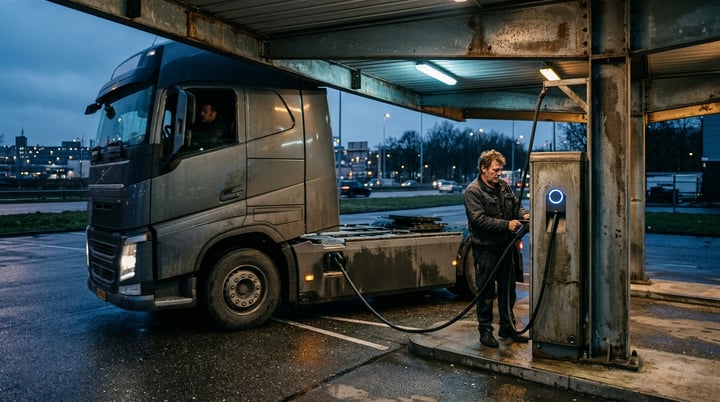
Rocsys from Rijswijk goes a step further: its system charges electric vehicles entirely hands-free, without a driver needing to plug in a cable. The company, founded in 2019, has raised $56 million to date and targets fleet operators with large numbers of vehicles, such as bus depots or port facilities. Both companies operate in a market that is growing as more businesses electrify their vehicle fleets and grid congestion becomes a more tangible operational constraint.
Tibo Energy from Eindhoven ties into the same theme. The company, founded in 2022 and financed with €6 million in 2025, focuses on energy management for businesses. By smoothing out consumption peaks it helps prevent congestion, which is also relevant for companies with charging infrastructure on their own premises.
Airports as a testing ground for recognition and access
Schiphol is one of the busiest airports in Europe and serves as the context for two recognition-focused startups. BagsID, based in Schiphol-Rijk and founded in 2018, uses algorithms to identify baggage regardless of whether a label is present or legible. The company raised €6.1 million in a seed round in 2022 and works with airports and airlines that lose or misroute luggage.
20face, from Enschede, founded in 2017 and financed with €36.8 million in a Series D in 2022, offers privacy-safe facial recognition for access control. Travellers or staff enter an area without a pass or PIN code. The combination of biometrics and privacy protection is technically complex, particularly under the European GDPR. The company thereby also positions itself as a response to European regulation, not just as a technological solution.
Robots in the logistics chain
Logistics centres are struggling with staff shortages and rising throughput volumes. Three Dutch robotics companies are targeting this segment, each with its own focus.
Smart Robotics from Best, founded in 2015 and financed with €8.7 million in 2024, builds systems for palletising and order picking. Fizyr from Delft, founded in 2014 with €4.5 million in seed financing, supplies vision software that enables industrial robots to perform unstructured tasks as well, such as gripping randomly stacked boxes. Avular from Eindhoven, founded in 2014 and financed with €3.5 million in a Series A in 2024, develops autonomous ground and aerial robots for industrial environments where people face safety risks.
The three companies work within the same chain, but at different levels: software layer, gripping system and autonomous vehicle. Collaboration or integration between parties of this kind is common in the sector.
Data and quality control as enabling conditions
Reliable mobility requires more than hardware. Weather Solutions from The Hague, founded in 2017 and financed with €42.3 million in a Series B in 2022, provides tailored weather data and forecasts for the energy, mobility and agriculture sectors. For logistics planners and transport companies, accurate weather forecasting is an operational tool for estimating delays, routes and energy consumption.
RESONIKS from Maarssen, founded in 2022 with €2.6 million in seed financing, detects internal defects in production components through acoustic analysis. In the mobility and manufacturing industry, where component safety is directly linked to operational reliability, early fault detection is a competitive advantage. The company focuses on quality control in production processes, one step earlier in the chain than most of the other parties mentioned.
Lleverage from Amsterdam, founded in 2024 with €3 million in seed capital, automates administrative back-office processes for traditional companies including those in the manufacturing industry. For transport companies with large amounts of paperwork around bills of lading, invoicing and planning, process automation is a direct cost item.
What holds this field together
The companies in this overview are not connected by a single technology or investor. What links them is that they are all working on components of the same system: moving goods and people in a way that consumes less energy, requires less staff or makes fewer errors. The geographic spread, from Venlo to Enschede and from Rijswijk to Eindhoven, reflects the presence of technical universities and industrial clusters across the Netherlands.
For investors and policymakers it is relevant that many of these companies are at a stage where the first major clients have been secured but scalability has yet to be proven. Rocsys and Weather Solutions have raised the most capital, at $56 million and €42.3 million respectively; companies such as Avular and Lleverage are at the start of that curve. European regulation on vehicle emissions, grid congestion and privacy protection creates both pressure and demand for this type of solution, which will partly determine the market dynamics for these startups in the years ahead.