Almost every company preparing for the quantum era is doing the same thing: swapping out old algorithms for new, harder ones. NIST published the standards, vendors are shipping migrations, and procurement departments across Europe are ticking the box. Fortaegis, an Amsterdam company that just closed an oversubscribed $50 million Series A, is doing something else. It is trying to remove the thing attackers go after in the first place: the stored key.
Who wrote the cheques, and why it matters
The round was announced on 14 September 2026 and led by Serendipity Capital, the Singapore firm that also wrote Fortaegis its $10 million seed [1]. Oversubscribed, valuation undisclosed. Before this, the company had raised somewhere north of €15 million in total, which makes the Series A roughly a fourfold step up in a single move [8]. Fortaegis was founded in Amsterdam barely three years ago and still counts between 11 and 50 employees [1].
What is telling is not the size. It is who showed up.
What they bring beyond money: Serendipity Capital (lead), Asian distribution, and continuity from the seed round [1]; TEL Venture Capital: The investment arm of Tokyo Electron, one of the world's largest chip equipment makers [1][2]; TNO (via TNO Ventures): Dutch applied research institute, R&D partner and platform validator [4]: Prodrive Technologies: Equity stake plus the Eindhoven assembly and integration line [8]; NP-Hard Ventures, NovaCapital, Access Ventures, Coalition Capital: Financial syndicate alongside the strategics [1]
Three of those five are not really investors. They are supply chain. Tokyo Electron sits upstream of every advanced fab on earth, Prodrive builds the boxes, and TNO both tests the technology and now owns part of the company that makes it. For a hardware startup that has to get from prototype to volume, that is worth more than the capital.
The angel list carries its own signal: Ilyas Khan, founder of Quantinuum and already Fortaegis chair and founding shareholder; Ian Fujiyama of Carlyle, whose background sits in aerospace and government services; and historian Peter Frankopan of Oxford [1]. Quantum credibility, defence procurement credibility, and a geopolitics thinker on the same line of a cap table is an unusual combination.
The money goes to one thing: getting out of the lab. Fortaegis is manufacturing in small quantities today and wants thousands of units by mid-2027, tens of thousands after that, with regional supply chains across the US, Europe and Asia [6]. Commercial manufacturing is slated for 2027, the custom ASIC for around 2028 [1][5].
Skipping the math war
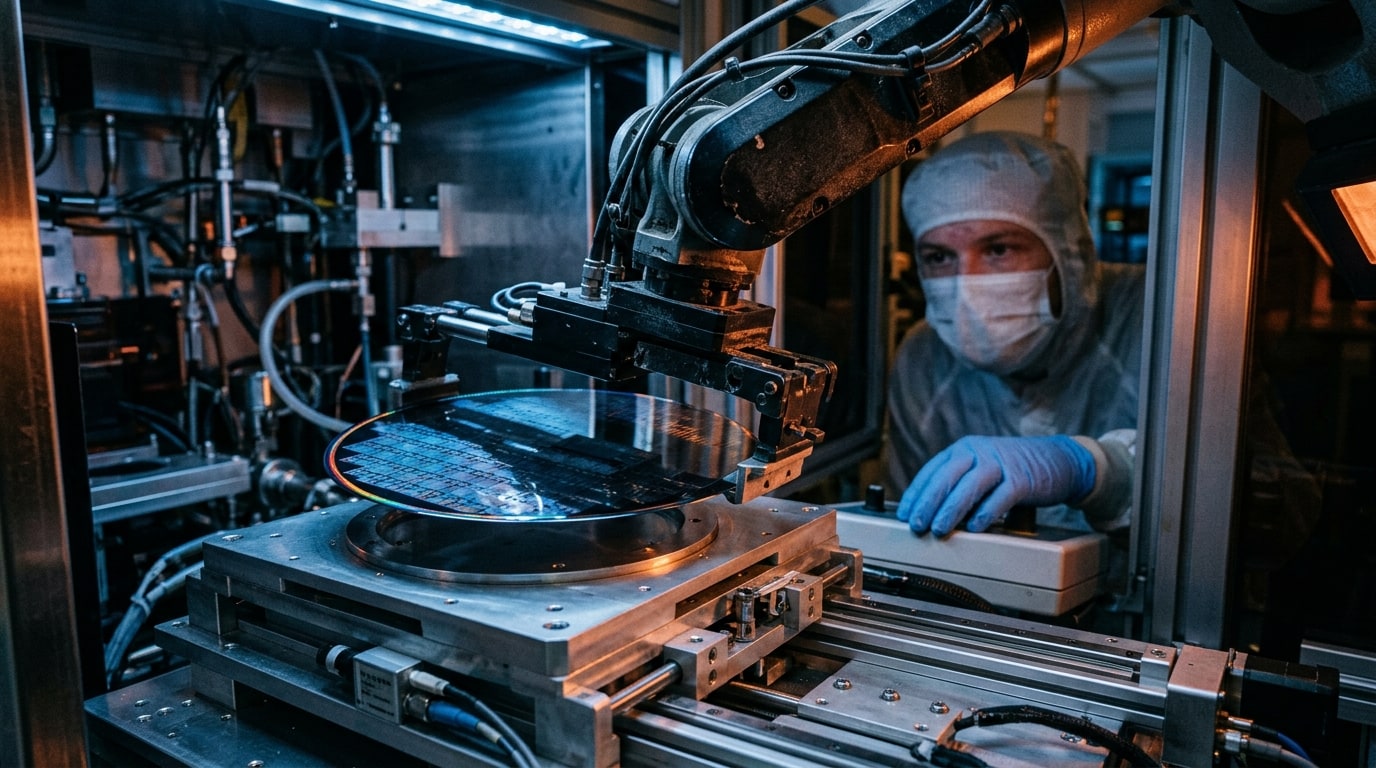
The bet sits in the silicon itself. Every chip that comes off a production line carries microscopic manufacturing imperfections, unique and effectively impossible to clone. That is a Physically Unclonable Function, or PUF, and it is not a new idea. What Fortaegis claims to have built around it is a full-stack architecture: hardware, firmware, cryptography and software, with identity, policy and orchestration extended across every enabled node [1][3].
The consequence is the interesting part. If a key is derived from the physics of the chip at the moment it is needed, there is no key sitting in storage and none travelling across the network to be intercepted. A future quantum computer that breaks RSA finds nothing to break [4]. Fortaegis claims authentication speeds of up to 100 times faster than traditional methods, and other reporting cites a figure of 200 times faster for secure transmission [2][5]. Both numbers come from the company. Independent benchmarks are not public, though TNO says it has tested and validated the platform's performance [4].
Founder and CEO Boudewijn Wijnands puts the thesis bluntly:
"The whole thesis that we have is embedded security not on the software layer, but on the hardware and the silicon itself." [6]
Wijnands is not a chip industry lifer. He read for an MSc at Oxford, previously founded Deedmob, a platform for civil society, and sits on the Dutch think tank DenkWerk [7]. The technical bench came later: CTO Pradeep Elamanchili, chip engineer Rahul Vyas, and a team of engineers, scientists and national security operators [3][5]. Chairing the company is Ilyas Khan, founder of Quantinuum, also a founding shareholder and a personal investor in this round [1].
A pipeline is not an order book
Here is where a careful reader should slow down. Fortaegis reports working with more than 25 enterprises and governments, non-recurring engineering contracts worth millions of dollars, and a commercial pipeline valued at $2.6 billion [6]. That last figure is explicitly not signed orders. The gap between a few million in engineering contracts and a multi-billion pipeline is the entire company risk, compressed into one line.
| What is announced | What it actually means today | |---|---| | $2.6bn commercial pipeline | Unsigned. Revenue to date is NRE contracts in the millions [6] | | Quantum-safe architecture | By design, not by certification against a published standard [4][5] | | NATO, ASML, TNO involvement | Experiments and R&D programmes, not volume procurement [1][2] | | Commercial manufacturing | FPGA units at thousands-scale by mid-2027; custom ASIC later [6] |
A second risk hides inside the elegance of the approach. European and NATO procurement frameworks are increasingly written around post-quantum cryptography standards. Fortaegis is not competing inside that race, it argues the race is the wrong one. Technically defensible. Commercially, it means every buyer must be sold a category, not just a product. That is a slower sale.
Sovereign, with an asterisk
Fortaegis frames itself around technological sovereignty, "strengthening the technological foundations of the West and its allies" [3]. Look at the cap table and the supply chain and the picture gets more textured. The lead investor is Singaporean. A major backer is TEL Venture Capital, the investment arm of Tokyo Electron. The chips are fabricated by TSMC in Taiwan. What is genuinely Dutch is the architecture, the IP, and the assembly: Prodrive Technologies in Eindhoven handles assembly and integration and took an equity stake, after Fortaegis specifically insisted on a European partner for that step [8].
That is not hypocrisy. It is what sovereignty realistically looks like for a European hardware company in 2026. You cannot build a leading-edge chip without Taiwan. You can control the design, the keys and the assembly, and Fortaegis has chosen those three.
The domestic backing is real. TNO invested through TNO Ventures, contributed to the software foundations early on, and now runs drone communication projects with the company [4]. Worth naming the awkwardness: the institute validating the performance is also a shareholder.

What is actually at stake
Fortaegis holds 17 filed patents with 14 more pending, a European assembly line, strategic capital from a chip equipment giant, and a NATO experimentation slot [1][6]. Against that: FPGAs are the product today, the ASIC arrives around 2028, and hardware cycles punish anyone who guesses the requirement wrong three years out. Soft commitments for a Series B are already in place [6].
Wijnands has argued that "security cannot remain something we add on top of digital systems, it must become part of the foundations of compute itself" [1]. Whether he is right is a technical question. Whether the market will pay for it before 2028 is a different one, and it is the one that decides this company.
---
References
[1] The Quantum Insider (2026). Fortaegis Raises $50 Million to Commercialize Chip-Based Security Technology. https://thequantuminsider.com/2026/09/14/fortaegis-raises-50-million-to-commercialize-chip-based-security-technology/
[2] Techzine Global (2026). Dutch company Fortaegis raises $50 million for chip security. https://www.techzine.eu/news/infrastructure/144251/dutch-company-fortaegis-raises-50-million-for-chip-security/
[3] Fortaegis (2026). Fortaegis Silicon Platform / Secure Compute Architecture. https://fortaegis.com/
[4] TNO (2025). TNO joins Dutch chip security company Fortaegis as partner. https://www.tno.nl/en/newsroom/2025/07/tno-joins-dutch-chip-security-company/
[5] The Quantum Insider (2025). Startup Fortaegis Says Its Hardware is Ready For Today's Security Challenges. https://thequantuminsider.com/2025/05/13/startup-fortaegis-says-its-hardware-ready-for-todays-security-challenges-perfectly-positioned-for-tomorrows-quantum-era/
[6] Resilience Media (2026). Fortaegis raises $50m to scale secure silicon for defence. https://resiliencemedia.co/fortaegis-raises-50m-to-scale-secure-silicon-for-defence/
[7] Fortaegis (2026). Boudewijn Wijnands. https://fortaegis.com/boudewijn-wijnands
[8] Bits&Chips (2026). Prodrive to assemble Fortaegis security chips in Eindhoven. https://bits-chips.com/article/prodrive-to-assemble-fortaegis-security-chips-in-eindhoven/
[9] io+ (2025). Dutch startup Fortaegis reinvents AI chip security. https://ioplus.nl/en/posts/dutch-startup-fortaegis-reinvents-ai-chip-security