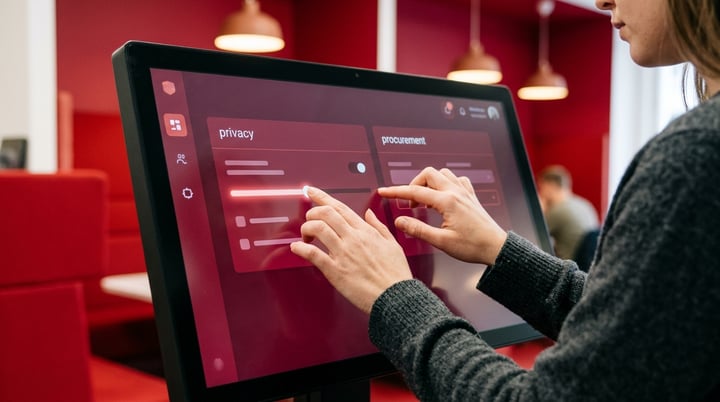
In many agencies and product teams, employees already use AI assistants on a daily basis, but each does so in their own way, with their own prompts, in their own accounts. What one person learns stays with that person. Mantle Chat, founded in Amsterdam, aims to break that pattern by anchoring AI use in collaboration itself.
The company is building a workspace where team chat, more than sixty AI models, shared agents, company knowledge and automated workflows come together. Katja Danilina, who describes herself on LinkedIn as co-founder and says she sets the company's direction, positions Mantle Chat as an alternative to the patchwork of separate AI tools that has emerged in many teams. The open beta went live on 13 November 2025; on 19 May 2026 a broader launch followed via Product Hunt.
What the platform offers
The core of Mantle Chat is a chat interface that works like a regular team communication tool, but in which every conversation gives direct access to AI models from OpenAI, Anthropic, Google, xAI, DeepSeek and other providers. Employees can call models from team channels, much like tagging a colleague in a message.
Conversations can be shared within a team, so that the context and outcomes of an AI session remain available to others. The same applies to agents, autonomous AI tasks that are run manually, on a schedule or in response to an event. This allows recurring tasks, such as summarising meetings or monitoring incoming messages, to be automated without each employee having to set them up separately.
The platform also includes collaborative documents, a shared team knowledge base, voice calls with automatic AI notes, and more than thirty integrations for both channels and agents. A native macOS desktop app and search across messages and documents complete the offering. The company lists which integrations are available on its own website.
The problem Mantle Chat wants to solve
The target audience is knowledge-intensive teams, with an emphasis on digital agencies, research, content and consultancy firms, and B2B product teams. These are environments where employees started using AI early, but where the move to structured, shared use has lagged behind.
Mantle Chat frames the difference as one between individual experiments and shared organisational capacity. When an employee develops a good prompt or workflow, it currently disappears into a personal account or is passed on verbally. In Mantle Chat's workspace, such building blocks are jointly owned by the team, stored and reusable.
The idea is not new: similar claims are made by tools such as Slack plug-ins, Microsoft 365 Copilot and specialised applications like Notion AI. Mantle Chat differentiates itself in the breadth of what it offers in one place, and in its choice to position AI not as an add-on to existing software, but as the core around which collaboration is built.
Amsterdam as a base
Mantle Chat is based in Amsterdam and was founded in 2025. The company has not disclosed anything about funding or investors. The team did organise at least one physical event in the city, on 6 October at Pathé Tuschinski, although the year is not stated in the available announcement.
The launch via Product Hunt in May 2026 generated visibility within the international product community, which uses that platform mainly to attract early users and feedback. Mantle Chat has not yet published concrete usage figures or customer names.
For agencies and product teams looking to structure their AI use, the offer of an integrated workspace is relevant at a time when the market for such tools is very much in motion. The choice to offer multiple models side by side rather than tying the platform to a single provider gives teams some independence in how they deploy AI. Whether that becomes a deciding factor in practice depends on how quickly the platform can win further adoption beyond the early users who tested the beta.