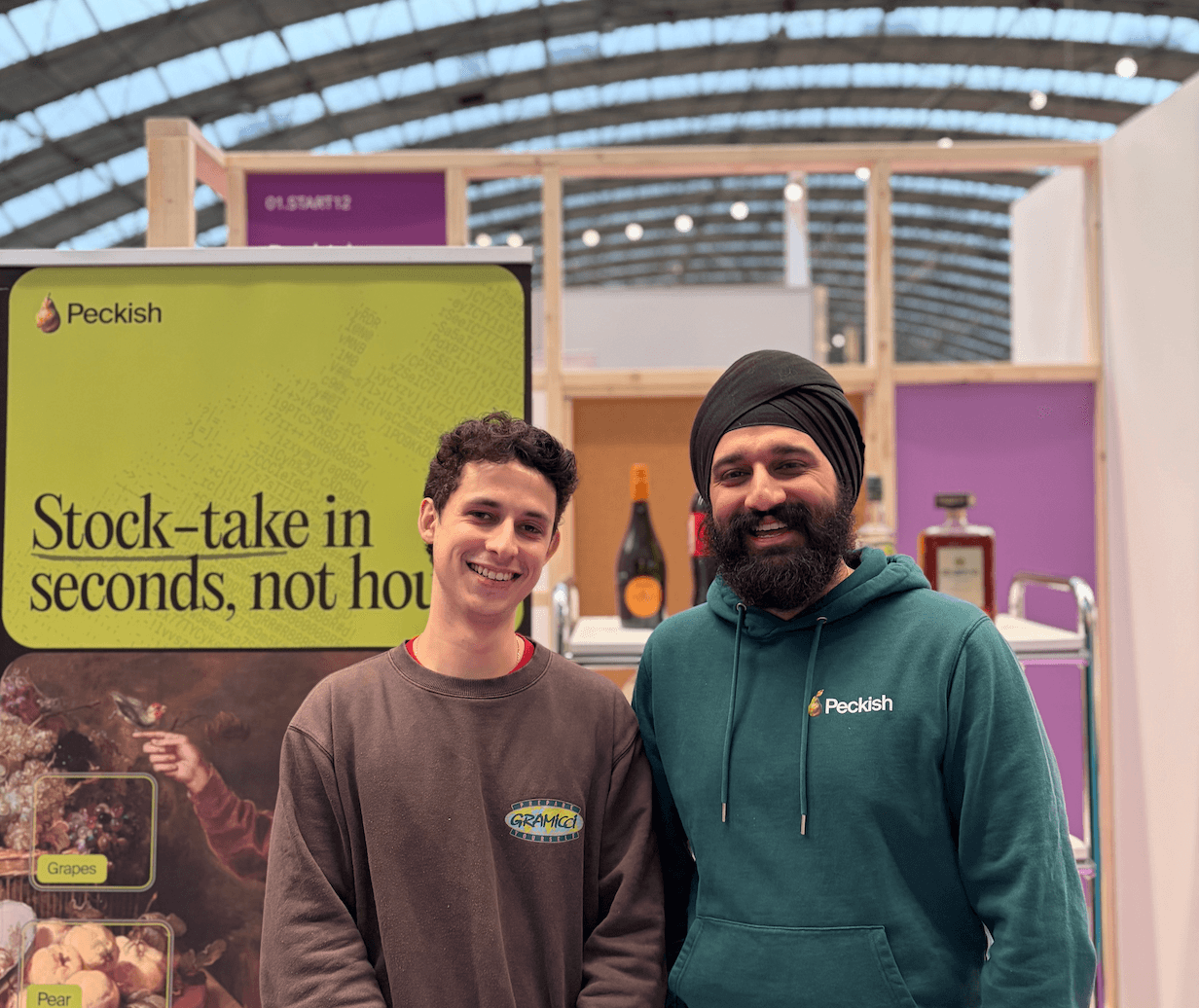
This is the promise of Peckish, an Amsterdam-based startup that treats restaurant inventory management as an AI problem rather than an accounting headache. Founded in 2023 by former Uber employees Harpreet Singh and Sebastien Pradier, the company raised an €800,000 pre-seed round in April 2025 led by Dutch angel group Arches Capital. It is now preparing a new funding round, scheduled for early 2026. But the real story is not the funding, it is the market gap they are exploiting.
The €132 billion inefficiency
Restaurants across Europe waste roughly 15 kilograms of food per person per year, contributing to the 59 million tonnes of food waste generated in the EU in 2022. The hospitality sector accounts for approximately 12% of total European food waste, representing an estimated market value of €132 billion disappearing every year. Yet the core problem is not negligence, it is invisibility.
Inventory management in restaurants remains stubbornly manual. Operators often spend 10 to 20 hours per week on stock counts and data entry, equivalent to a significant share of a full-time position. In a sector already under pressure from post-COVID staff shortages and rising food costs, this represents a structural inefficiency that traditional restaurant management software has not resolved.
The global restaurant inventory management software market, valued at approximately €610 million in 2024, is expected to surpass €1 billion in the early 2030s, growing at an annual rate of over 8%. But growth does not necessarily equal innovation.
Most existing solutions digitise the problem without reinventing it. They replace paper checklists with tablet forms. Peckish chose a different approach: eliminate the checklist entirely.
Computer vision, as inventory management
The Peckish mobile app uses computer vision to extract inventory data directly from short stock-room videos recorded in a dedicated mobile app. A manager films their shelves, refrigerators or storage areas, uploads the clip, and receives structured inventory data synchronised with their inventory system.
Invoice processing follows the same philosophy. Supplier invoices are photographed via the app, automatically parsed and matched against historical prices and current stock levels, with discrepancies such as price increases or missing items flagged accordingly.
Early versions of Peckish experimented with messaging-based workflows, but the company has since shifted to a mobile-app-first approach. The shift reflects a broader ambition: to become an operational system of record rather than a lightweight interface layer. The app integrates directly into daily restaurant routines while supporting richer feedback loops, quality controls and retraining signals for its models.
Under the hood, Peckish trains and deploys multiple computer vision models using cloud-based AI infrastructure. Rather than relying on a single model, the system combines visual recognition, historical sales data and inventory movement patterns to estimate actual consumption and detect anomalies.
Since its UK launch in 2024, Peckish reports having processed thousands of video-based stock counts and delivered meaningful time savings for restaurant teams. Customers typically report reclaiming several hours per week previously spent on manual inventory tasks, while gaining tighter control over variance and waste.
The hospitality execution test
The restaurant technology sector is littered with well-intentioned failures: polished interfaces that staff never adopt, sophisticated analytics that managers do not trust, integrations that break when point-of-sale systems are updated.
The backgrounds of Singh and Pradier in Uber's operational teams, combined with close ties to family businesses in the hospitality industry, inform a pragmatic approach to product development. The focus is less on dashboards and more on reducing friction in high-pressure environments where staff turnover is high and margins are thin.
Arches Capital partner Diederik Stolk noted this execution speed: "From quickly acquiring first customers, to establishing partnerships and building a great product. The team operates at record speed, with a deep understanding of hospitality operations" [11].
What comes next
Peckish is currently preparing a new seed funding round, scheduled for February–March 2026. The capital will be used to expand production capabilities, grow its proprietary dataset of food & beverage inventory images, and support further expansion in the United Kingdom, the Netherlands and additional international markets.
That dataset is strategic. Every stock-room video improves the system's ability to recognise products under varying lighting conditions, packaging variations and storage layouts. Over time, this feedback loop could become a meaningful moat, provided Peckish can maintain model performance at scale.
That assumption is not trivial. Computer vision systems in the hospitality sector must contend with constant change: suppliers rename products, kitchens reorganise storage, and new ingredients appear without warning. Accuracy, reliability and graceful failure modes will determine whether Peckish becomes infrastructure or remains a useful but limited tool.
Competition is intensifying. Both established restaurant software vendors and AI-native startups are moving into adjacent territory, offering waste tracking, logging and inventory automation. The market remains fragmented, and differentiation increasingly comes down to distribution and execution rather than raw technical capability.
Regulation may also play a role. In 2025, the European Parliament approved binding food waste reduction targets, including a 30% reduction in food waste by restaurants and food service operators by 2030. This could accelerate adoption of waste-tracking tools, or invite compliance-driven solutions that integrate directly with existing point-of-sale systems.
The fundamental question is not whether AI can improve restaurant inventory management, it already does. The question is whether Peckish can translate that capability into widespread adoption quickly enough to define the category before better-funded competitors converge on similar approaches.
In restaurant technology, the second-best product with superior distribution often wins.