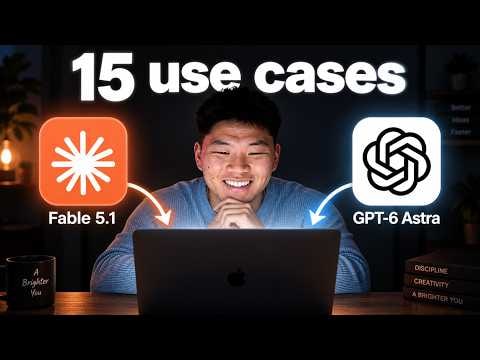
100 Hours Testing GPT-6 Astra vs Fable 5.1. What You Need to Know.
Nate Herk | AI Automation6 September 2026Watch on YouTube
Part of series
Ep. 4 · GPT-6 Astra vs Fable 5.1
Uitgebreide vergelijkingstests tussen GPT-6 Astra en Claude Fable 5.1 op coderen, design en praktische use cases.
View the seriesWhat you'll learn
- You learn how GPT-6 Astra and Claude Fable 5.1 perform across 15 different use cases
- You see both outputs per test side by side and which one the creator preferred
- You learn how output quality, time, and cost compare between the two models
- You discover where each model is stronger in tasks like presentations, sales copy, browser tasks, and software development
- You get insight into how the creator decides which model to use for daily work
Frequently asked questions
How many use cases does the creator test in this video?
Which aspects are compared per test?
Does the video give a final judgment on which model is best?
Topics
Description from the channel
My playbook for growing a $1M AI agency: https://app.aiautomationsociety.ai/opaa-ads-optin My FREE resources: https://www.skool.com/ai-automation-society/about?el=astra-6-vs-fable-5.1&hcategory=youtube-videos&utm_campaign=free-group My Tools💻 FREE MONTH voice to text: https://get.glaido.com/nate Code NATEHERK for 10% off VPS (annual plan): https://www.hostinger.com/vps/claude-code-hosting I tested GPT-6 Astra against Claude Fable 5.1 across 15 use cases, from presentations and sales copy to browser tasks, video editing, and building software. I walk through both outputs for each test, share which one I preferred, and compare the time and cost. You'll see where each model did better and how I'm deciding which one to use for my day-to-day work. Sponsorship Inquiries: 📧 nate@smoothmedia.co Connect with me: https://www.linkedin.com/in/nateherkelman/ https://x.com/nateherk https://www.instagram.com/nateherk/ TIMESTAMPS 0:00 Intro 0:44 Experiment 1 4:11 Experiment 2 6:27 Experiment 3 8:42 Experiment 4 11:51 Experiment 5 14:22 Experiment 6 17:44 Experiment 7 20:12 Experiment 8 22:19 Experiment 9 25:31 Experiment 10 27:33 Experiment 11 30:00 Experiment 12 30:51 Experiment 13 32:28 Experiment 14 34:53 Experiment 15 36:37 Conclusion