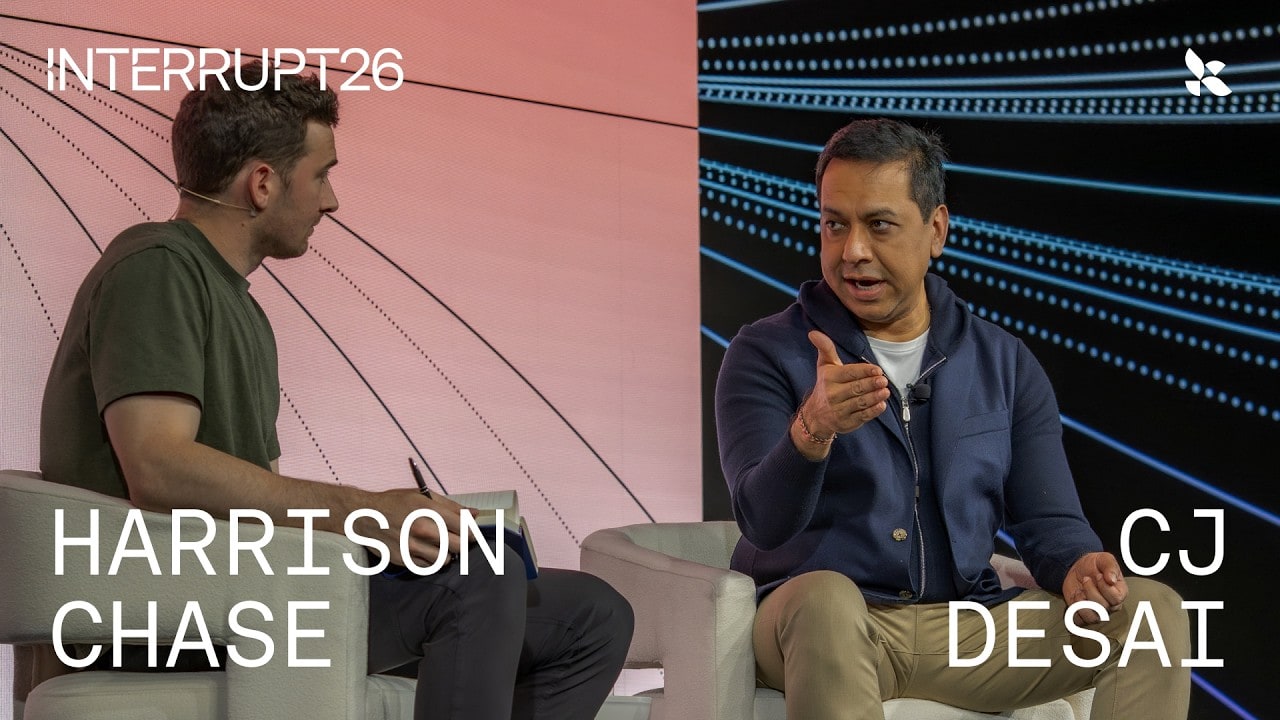
Agents in the Enterprise with MongoDB | Interrupt 26
LangChain16 June 2026Watch on YouTube
Part of series
Ep. 4 · LangSmith Engine: Agents bouwen
LangChain laat zien hoe LangSmith Engine het evalueren en verbeteren van AI-agents automatiseert via trace-analyse.
View the seriesWhat you'll learn
- You learn why enterprise AI is all about unstructured data and how MongoDB addresses this with native search, vector search and embeddings.
- You see how different customer types, from frontier labs and AI-native companies to enterprise customers, use MongoDB for AI, including the ElevenLabs case study.
- You discover the three-legged stool of an agent stack, LLM, data and harness layer, and how LangChain and MongoDB work together in this.
- You hear about the three buckets of agents, employee, partner and customer-facing, and why customer-facing agents are the real prize.
- You gain insight into real blockers such as stack paralysis, regulation and evals, plus MongoDB's internal stats where 70% of code is written by AI.
Frequently asked questions
Why was 2025 expected to be the year of agents but did not deliver?
Why can real-time agents not be built on data warehouses?
Which three buckets of agents are distinguished?
What percentage of code is written by AI at MongoDB?
Topics
In this video

Read next
Negen van de 21 Nederlandse fintech-startups zitten in de Metropoolregio Amsterdam
Van de 21 Nederlandse fintech-startups in dit overzicht is de Metropoolregio Amsterdam veruit het sterkst vertegenwoordigd. Historische financiële infrastructuur, internationale talentpools en innovatievriendelijk toezicht verklaren waarom juist daar zoveel bedrijven neerslaan.
Nederlandse fintech in 2026: AI domineert, funding stroomt en fraude professionaliseert
De Nederlandse fintech-sector telt ruim 860 actieve bedrijven met een gezamenlijke waardering van €14,2 miljard. AI, fraudebestrijding en betalingsinfrastructuur zijn in 2026 de meest actieve segmenten, aangejaagd door forse investeringsrondes en toenemende Europese regeldruk.
Stacks haalt $23 miljoen op in Series A en lanceert AI Flux Analysis
Het Amsterdamse fintech-bedrijf Stacks heeft op 19 februari 2026 een Series A-ronde van $23 miljoen afgesloten, geleid door Lightspeed. Tegelijk lanceerde het bedrijf AI Flux Analysis, een tool die variantieanalyse in financiële rapportages automatiseert.
De best gefinancierde fintech-startups van Nederland in 2026
Nederlandse fintech-startups haalden in 2026 opnieuw tientallen miljoenen op, met Silverflow, FRISS en Duna als koplopers. AI-gedreven fraudedetectie, compliance-automatisering en betalingsinfrastructuur trekken de meeste investeringen aan.
Kaiko haalt $110 miljoen op in Series B met S&P Global, Nasdaq en grote banken als investeerders
Het Parijse databedrijf Kaiko heeft zijn Series B-ronde uitgebreid naar $110 miljoen, geleid door S&P Global. BNP Paribas, Nasdaq Ventures en Royal Bank of Canada behoren tot de deelnemende investeerders.
Nebius haalt $5,75 miljard op via converteerbare obligaties voor datacenteruitbreiding
Het Amsterdamse AI-cloudbedrijf Nebius Group N.V. heeft een converteerbare obligatie-uitgifte van $5,75 miljard voltooid, bestemd voor de bouw en uitbreiding van datacenters en de aanschaf van AI-hardware. Het is de tweede grote obligatieronde van het bedrijf in 2026.
Description from the channel
Harrison Chase sits down with CJ Desai, CEO of MongoDB, for a fireside chat at Interrupt 2026, the agent conference by LangChain. Watch their full session for a deep dive on what's actually working (and not) for enterprises building AI agents at scale, why 2025's "year of agents" prediction didn't quite pan out, and so much more. 00:00 Introduction & welcome 01:01 MongoDB's founding principles & how they apply to AI 02:47 AI is all about unstructured data - how MongoDB fits in 03:16 Adding native search, vector search & embeddings 03:41 How different customer types use MongoDB for AI 04:43 Frontier Labs: research, inference & long-term memory 05:22 AI-native companies: the ElevenLabs case study 06:16 Enterprise customers: LangChain orchestration & internal agents 07:06 The three-legged stool: LLM + data + harness layer 08:01 The LangChain x MongoDB integration story 09:37 Open ecosystem vs. hyperscaler lock-in 10:36 Adobe's agent story: making the LLM the bottleneck 11:00 Will startup, enterprise & lab use cases converge? 11:29 Three buckets of agents: employee, partner & customer-facing 12:22 Why customer-facing agents are the real prize 13:00 A large insurance company's agent journey 14:26 The real blockers: stack choice, regulations & evals 15:44 Agent stack paralysis & why 2026 feels more stable than 2025 16:46 Token costs & the ROI of coding agents 18:06 MongoDB's internal stats: 70% of code written by AI 19:37 Token budgets & the human vs. tool cost equation 21:37 Open memory & the Context Hub announcement 22:07 System of intelligence: why context & memory will get bigger 23:37 Why real-time agents can't be built on data warehouses 24:47 Headless APIs & the future of software-via-UI 25:17 CJ's SaaS procurement strategy: cutting vendors in half 27:51 Which SaaS companies are safe vs. at risk 29:08 What makes a strong moat for Gen AI-native startups 29:56 Platform mindset: when 1 + 1 is more than 2 31:39 Wrap-up & thanks Extra resources: • Everything we shipped at Interrupt: https://www.langchain.com/blog/interrupt-2026-overview • Meet LangSmith Engine: https://www.langchain.com/blog/introducing-langsmith-engine • About LangChain: https://www.langchain.com/