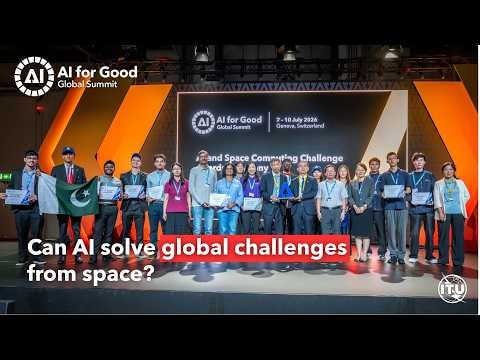
AI and Space Computing Challenge awards ceremony
AI for Good4 September 2026Watch on YouTube
What you'll learn
- You see the awards ceremony of the AI and Space Computing Challenge, organized by ITU's AI for Good.
- You learn which winners are recognized across the three tracks: Zero Hunger, Clean Water and Sustainable Cities.
- You discover how the Challenge builds on Zhejiang Lab's Three-Body Computing Constellation.
- You hear Frederic Werner of ITU about the mission and outcomes of the global competition.
- You see how AI and space computing are applied to sustainable development goals.
Frequently asked questions
What is the AI and Space Computing Challenge?
Which three tracks does the Challenge have?
Where was the awards ceremony recorded?
Who presents the ceremony and the summary?
Topics
Description from the channel
Can AI and space computing help tackle some of the world’s most pressing global challenges? The AI and Space Computing Challenge awards ceremony highlights innovative algorithmic solutions addressing three major challenges aligned with zero hunger, clean water, and sustainable cities and communities. Built around Zhejiang Lab’s Three-Body Computing Constellation, the Challenge explores how AI and space-computing technologies can support sustainable development while fostering international cooperation and innovation. Frederic Werner, Chief of the Strategic Engagement Department and AI for Good at the International Telecommunication Union (ITU), presents a summary of the competition and its global mission. The ceremony is moderated by Yapeng Wang, Programme Officer in the Telecommunication Standardization Bureau (TSB) at ITU. The session recognises the winners across the Challenge’s three tracks: Zero Hunger, Clean Water and Sustainable Cities, showcasing the growing global interest in applying AI and advanced space computing to shared challenges facing humanity. Recorded live at the AI for Good Global Summit 2026 at Palexpo in Geneva, Switzerland. ____________________________________________________________________ AI for Good is identifying innovative AI applications, building skills and standards, and advancing partnerships to solve global challenges. AI for Good is organized by ITU in partnership with over 50 UN partners and co-convened with the Government of Switzerland. Join the Neural Network! 👉https://aiforgood.itu.int/neural-network/ The AI for Good networking community platform powered by AI. Designed to help users build connections with innovators and experts, link innovative ideas with social impact opportunities, and bring the community together to solve global challenges using AI. 🔴 Watch the latest #AIforGood videos! https://www.youtube.com/c/AIforGood/videos 📩 Stay updated and join our weekly AI for Good newsletter: http://eepurl.com/gI2kJ5 🗞Check out the latest AI for Good news: https://aiforgood.itu.int/newsroom/ 📱Explore the AI for Good blog: https://aiforgood.itu.int/ai-for-good-blog/ 🌎 Connect on our social media: Website: https://aiforgood.itu.int/ X: https://twitter.com/AIforGood LinkedIn Page: https://www.linkedin.com/company/26511907 LinkedIn Group: https://www.linkedin.com/groups/8567748 Instagram: https://www.instagram.com/aiforgood Facebook: https://www.facebook.com/AIforGood Disclaimer: The views and opinions expressed are those of the panelists and do not reflect the official policy of the ITU.