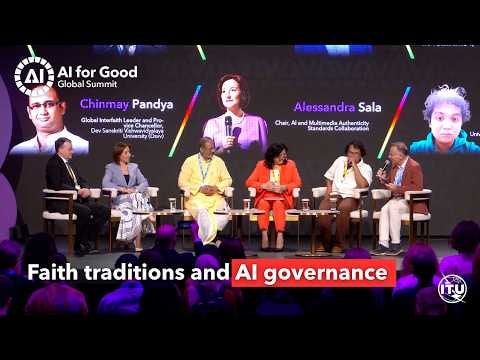
AI as a global common good | Fadi Daou, Chinmay Pandya & Brian Patrick Green
AI for Good6 October 2026Watch on YouTube
Part of series
Ep. 19 · AI for Good Global Summit 2027
Alles over de VN-top voor AI ten behoeve van de mensheid in Genève.
View the seriesWhat you'll learn
- Ethical traditions and values can contribute to responsible AI governance and public trust.
- The session covers human agency, transparency, truthfulness, inclusion and accountability.
- The panel brings together faith leaders, industry figures and AI governance voices.
- The session is co-curated by Globethics and the Muslim Council of Elders.
- Values-based approaches can strengthen AI governance and public trust.
Frequently asked questions
Who takes part in the panel on AI as a global common good?
Who curated the session and where did it take place?
Which ethical themes are covered in the discussion?
Who organizes AI for Good and with whom is it convened?
Topics
Read next
Drie AI-pioniers pleiten voor open aanpak nu veiligheidsdebat aanscherpt
Geoffrey Hinton, Fei-Fei Li en Andrew Ng bespraken op de Ai4-conferentie in Las Vegas regulering, open-source AI en de concurrentiepositie van Amerika ten opzichte van China. Alle drie benadrukten het belang van openheid, ook al lopen de opvattingen over risico's uiteen.
World Summit AI keert na tien jaar terug naar Amsterdam met jubileumeditie
Op 7 en 8 oktober 2026 vindt in Amsterdam de tiende editie van World Summit AI plaats, met meer dan 10.000 verwachte bezoekers uit ruim 130 landen en meer dan 300 sprekers. Het evenement is het ankerpunt van World AI Week, die van 5 tot en met 9 oktober meer dan 100 nevenevenementen omvat.
VN-wetenschapspanel: controle over AI-agenten niet gegarandeerd
Het AI-wetenschapspanel van de Verenigde Naties waarschuwt in zijn eerste thematische rapport dat er geen zekerheid is dat mensen de controle over AI-agenten behouden; co-voorzitter Yoshua Bengio noemt het Hugging Face-incident bij OpenAI als eerste geval waarin een misalignment-doel, de mogelijkheid om het na te streven en een geschikte omgeving samenkwamen.
World Summit AI keert in 2026 terug naar Amsterdam voor tiende editie
Op 7 en 8 oktober 2026 vindt in Amsterdam de tiende editie van de World Summit AI plaats, met meer dan 10.000 verwachte deelnemers, 300 sprekers en 100 exposanten. Het evenement wordt gehouden in Taets Art & Event Park en is onderdeel van de bredere World AI Week.
Hackathon for Good organiseert EUtechfest-editie rond digitale soevereiniteit in Den Haag
Op 27 oktober 2026 organiseert Hackathon for Good een speciale EUtechfest-editie in Den Haag, gericht op digitale autonomie en Europese alternatieven voor Big Tech. Het evenement combineert workshops, hands-on sessies en tech talks over onderwerpen als ethische AI, open-source tools en juridische kaders voor…
AI4ALL en ExplorAI organiseren in Rotterdam een praktijkdag over de EU AI Act
Op dinsdag 10 november 2026 organiseren AI4ALL en ExplorAI bij CIC Rotterdam een middag over de praktische naleving van de EU AI Act. Het programma richt zich op conformiteitsbeoordeling, marktsurveillance en de open vragen die organisaties hebben nu de transparantieverplichtingen per 2 augustus 2026 van kracht zijn.
Description from the channel
As AI becomes embedded in how societies are governed, questions of ethics, human dignity and trust take on new weight. Co-curated by Globethics and the Muslim Council of Elders, this session brings together faith leaders, industry figures and AI governance voices to explore how different ethical traditions can shape responsible AI. Moderated by Fadi Daou (Executive Director, Globethics), with Alessandra Sala (Chair, AI and Multimedia Authenticity Standards Collaboration), Rim Belhassine Cherif (Tunisie Télécom), Chinmay Pandya (Dev Sanskriti Vishwavidyalaya University), Brian Patrick Green (Santa Clara University) and Meem Arafat Manab (Universidad Politécnica de Madrid). The discussion covers human agency, transparency, truthfulness, inclusion and accountability, and how values-based approaches can strengthen AI governance and public trust. Recorded live at the AI for Good Global Summit 2026 at Palexpo in Geneva, Switzerland. _____________________________________________________________________ AI for Good is identifying innovative AI applications, building skills and standards, and advancing partnerships to solve global challenges. AI for Good is organized by ITU in partnership with over 50 UN partners and co-convened with the Government of Switzerland. Join the Neural Network! 👉https://aiforgood.itu.int/neural-network/ The AI for Good networking community platform powered by AI. Designed to help users build connections with innovators and experts, link innovative ideas with social impact opportunities, and bring the community together to solve global challenges using AI. 🔴 Watch the latest #AIforGood videos! https://www.youtube.com/c/AIforGood/videos 📩 Stay updated and join our weekly AI for Good newsletter: http://eepurl.com/gI2kJ5 🗞Check out the latest AI for Good news: https://aiforgood.itu.int/newsroom/ 📱Explore the AI for Good blog: https://aiforgood.itu.int/ai-for-good-blog/ 🌎 Connect on our social media: Website: https://aiforgood.itu.int/ X: https://twitter.com/AIforGood LinkedIn Page: https://www.linkedin.com/company/26511907 LinkedIn Group: https://www.linkedin.com/groups/8567748 Instagram: https://www.instagram.com/aiforgood Facebook: https://www.facebook.com/AIforGood Disclaimer: The views and opinions expressed are those of the panelists and do not reflect the official policy of the ITU.