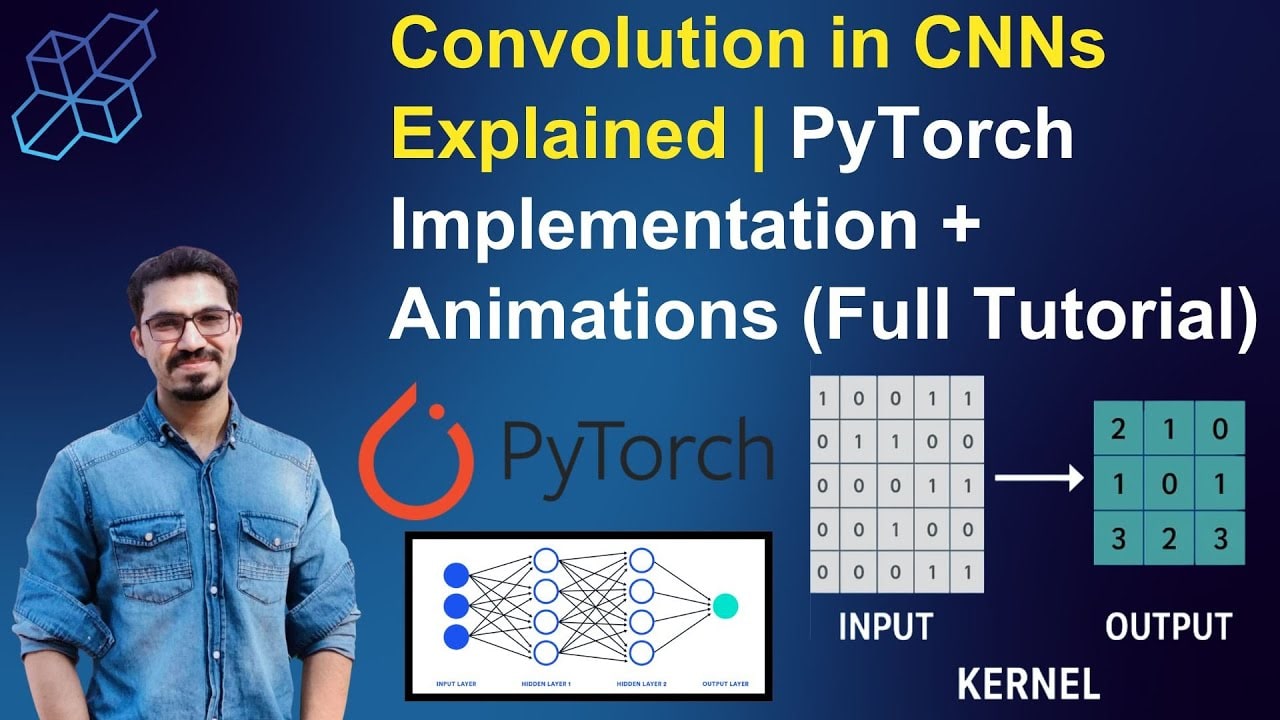
Convolution in CNNs Explained | PyTorch Implementation + Animations (Full Tutorial)
AI Sciences16 June 2026Watch on YouTube
What you'll learn
- Convolution is the core operation in CNNs where a kernel (filter) slides over an image and computes dot products to generate feature maps
- The output size of a convolution follows the formula (input size − kernel size + 1), and padding helps preserve dimensions
- You can implement convolution step-by-step with NumPy (nested loops and dot products) before using PyTorch's nn.Conv2d for real-world applications
Frequently asked questions
What is a kernel in the context of convolution?
How does stride affect the output of convolution?
What is the advantage of padding in convolutional layers?
How does NumPy implementation differ from PyTorch for convolution?
Topics
In this video

Read next
Nvidia-onderzoek: AI-instructie belangrijker dan modelkwaliteit
Nvidia-onderzoek toont aan dat AI-agenten goed kunnen presteren door fijnafstemming van de instructies, zelfs met een zwakker basismodel.
CoreWeave legt AI-platform laag voor laag uit, van datacenter tot modelmonitoring
CoreWeave heeft in een publieke sessie zijn volledige AI-platform toegelicht, van eigen datacenters met GPU-clusters tot orkestratietools en realtime diagnostiek voor trainingsprocessen. Het bedrijf schaalt naar meer dan 40 datacenters met een gezamenlijk vermogen van 850 megawatt.
Google Research presenteerde TurboQuant, een compressietechniek voor de KV-cache van taalmodellen
Google Research kondigde in maart 2026 TurboQuant aan, een algoritme dat de Key-Value cache van grote taalmodellen compresseert van 16 bit naar 3 bit, met een geheugenreductie van tot zes keer en een snelheidswinst van tot acht keer op NVIDIA H100-GPU's.
Snowflake Decision in private preview binnen Cortex AI Functions
Snowflake Decision brengt via AI_COMPLETE in Cortex AI Functions snelle, gestructureerde classificatie, scoring en routing naar SQL, nu in private preview.
Handvatten voor het opbouwen van AI-vaardigheden
Richtlijnen voor het gebruik van Claude Code waarbij het raadzaam is API-documentatie direct te gebruiken in plaats van op gissingen te vertrouwen.
Google Research publiceert TurboQuant, een compressiealgoritme voor grote taalmodellen
Google Research heeft TurboQuant gepubliceerd, een algoritme dat de KV-cache van grote taalmodellen comprimeert tot ongeveer 3 bits. Volgens de onderzoekers leidt dit tot zes keer minder geheugengebruik en acht keer hogere doorvoer op dezelfde GPU-hardware, zonder nauwkeurigheidsverlies.
Description from the channel
Course link:https://aicourse.thinkific.com/courses/new-course-1 00:00 – Introduction to Convolution 06:12 – Convolution Animations 16:30 – Convolution using Pytorch In this video, we dive deep into the core building block of Convolutional Neural Networks: We begin by understanding how an image is represented as a numeric array and how a 3×3 kernel (filter) slides over the input image to generate a feature map. Using clear examples, dot-product demonstrations, and step-by-step window shifting, you will learn how the output size is calculated using the formula (input size − kernel size + 1) and how padding can preserve dimensions. After visual understanding, we implement the convolution operation manually in NumPy using nested loops, patches, and dot products. Then we move toward real-world visuals with animations showing kernel projection, stride effects, and interactive filter demos. Finally, we rewrite the entire convolution process using PyTorch’s nn.Conv2d, explore image pre-processing, tensor dimensions, custom kernels, and view side-by-side original vs convolved images. This complete workflow takes you from concept → NumPy implementation → PyTorch implementation, preparing you for deeper CNN concepts ahead. ✅ Stay Connected to Us. 👉 Twitter: https://twitter.com/AISciencesLearn 👉 Facebook: https://www.facebook.com/AISciencesLearn 👉 LinkedIn: http://www.linkedin.com/company/ai-sciences 👉 Website: http://www.aisciences.io ✅ For Business Inquires: contact@aisciences.io ============================= ✅ Important Python Projects: 👉 Get a look at our course on data science and AI here: https://bit.ly/3thtoUJ 👉 The Python Codes are available at this link: https://www.aisciences.academy/ytube-cfd ✅ Recommended Playlists: 👉 Artificial Intelligence https://www.youtube.com/playlist?list=PLVgEzPHodXi0tO_iLwoZcEXiFPekTZlyj 👉 Machine Learning https://www.youtube.com/playlist?list=PLVgEzPHodXi01AWPo06GOsM-ba_e1PJ1l ✅ Other Videos You Might Be Interested In Watching: 👉 Simplest Password Cracker Using Python | Tips and Tricks | Most Easy https://www.youtube.com/watch?v=EmwmbahsM_E 👉 Build Facebook's Wav2Vec2 Model For Speech To Text Application | Easy Python Tutorial https://www.youtube.com/watch?v=t_qDAqUfqhY 👉 Fake Currency Detection Using Logistic Regression Model | Python | Tutorial For Beginners https://www.youtube.com/watch?v=dJO69JzldmQ 👉 Question Answering Bot | AI Based | with Hugging Face Transformers | Python https://www.youtube.com/watch?v=s4rV6Wyp23A ============================= ✅ About AI Sciences. AI Sciences is an e-learning company; the company publishes online courses and books about data science and computer technology for anyone, anywhere. We are a group of experts, Ph.D. students, and young practitioners of artificial intelligence, computer science, machine learning, and statistics. Some of us work for big-name companies like Google, Facebook, Microsoft, KPMG, BCG, and Mazars. We decided to produce courses and books mainly dedicated to beginners and newcomers on the techniques and methods of machine learning, statistics, artificial intelligence, and data science. Initially, our objective was to help only those who wish to understand these techniques more easily and to be able to start with less theory or lengthy reading. Today, we publish more complete books on selected topics for a wider audience. 🔔 Subscribe To our Channel For More Content of Data Science, Machine Learning, and AI: https://www.youtube.com/@AISciencesLearn ================================= #predictionofsocialmediafollowers #socialmediafollowersbymachinelearning #socialmediamarketing #socialmediamarketingforbeginners Disclaimer: We do not accept any liability for any loss or damage which is incurred by you acting or not acting as a result of watching any of my publications. You acknowledge that you use the information I provide at your own risk. Do your own research. Copyright Notice: This video and my YouTube channel contain dialog, music, and images that are the property of AI Sciences. You are authorized to share the video link and channel and embed this video in your website or others as long as a link back to my Youtube Channel is provided. © AI Sciences