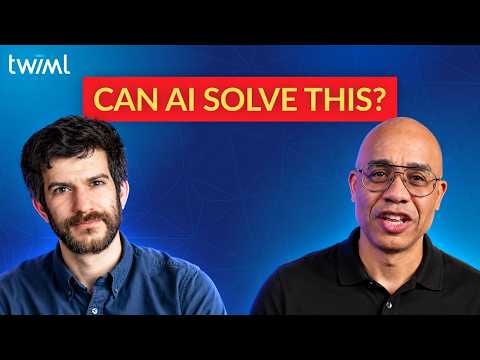
From Math Olympiads to Navier-Stokes: How Fast Is AI Progressing?
The TWIML AI Podcast with Sam Charrington3 October 2026Watch on YouTube
What you'll learn
- AI systems have evolved from grade-school math to contributing to research problems such as Navier-Stokes.
- Traditional benchmarks are saturating, which is why the Epoch Capabilities Index is needed to keep measuring progress.
- Capability gains appear surprisingly steady across model generations, pointing to linear progress.
- Models still struggle with open-ended work, learning from experience, and identifying promising research directions.
- When solving hard math problems, models rely on persistence and prior human work.
Frequently asked questions
Why are traditional benchmarks becoming less useful for measuring AI progress?
How do AI systems solve hard math problems according to the episode?
Where do models still struggle?
How do you measure progress when the answers are unknown, as with FrontierMath?
Topics
Read next
OpenAI en Anthropic claimen allebei een weerlegging van de Exponential Time Hypothesis
OpenAI en Anthropic publiceerden op 26-27 oktober 2026 onafhankelijk van elkaar papers waarin hun interne modellen de Exponential Time Hypothesis (ETH) zouden weerleggen. Beide claims zijn nog niet onafhankelijk geverifieerd; een externe reviewgroep is ingesteld.
OpenAI claimt drie nieuwe wetenschappelijke resultaten, wiskundigen wachten op verificatie
OpenAI kondigde op 26 oktober 2026 drie resultaten aan die door zijn modellen zouden zijn geproduceerd op het gebied van wiskunde, complexiteitstheorie en kwantumveldentheorie. Geen van de resultaten is tot nu toe onafhankelijk beoordeeld via peer review.
AI-labs melden doorbraken bij wiskundeproblemen
OpenAI, Anthropic en andere labs hebben het afgelopen jaar doorbraken gemeld bij langdurig onopgeloste wiskundeproblemen, waaronder een van de Millennium Prize-problemen, wat discussie over werkwijze en verificatie oproept.
OpenAI publiceert 722 manuscripten met wiskunde-oplossingen van onuitgebracht model
OpenAI heeft oplossingen voor langdurige wiskundeproblemen vrijgegeven, geproduceerd door een nog niet uitgebracht frontier-model, in 722 manuscripten over 372 resultaatsfamilies.
Studie: AI-agenten overschatten eigen resultaten en zijn verre van autonoom onderzoek
Epoch AI en Anthropic concluderen onafhankelijk dat modellen zoals GPT-5.6 Sol en Claude Fable 5 experimenten kunnen uitvoeren maar wetenschappelijke zelfkritiek en echte creativiteit missen, met maximaal 15 procent van de menselijke referentiescore.
Anthropic-model boekt vooruitgang op grote wiskundeprobleem
Een niet-uitgebrachte AI-model van Anthropic heeft meer progressie geboekt op de Riemann-hypothese, een meer dan 150 jaar oud onopgelost mathematisch probleem, dan verwacht werd.
Description from the channel
AI systems have gone from struggling with grade-school math to helping solve research problems that have resisted mathematicians for decades, including Navier-Stokes. In this episode, Greg Burnham, who leads AI capabilities research at Epoch AI, joins us to examine what that progress says about where AI is going. We look at how these systems are solving hard math problems, how much they rely on persistence and prior human work, and whether they are starting to produce genuinely new ideas. We also discuss how to measure progress as traditional benchmarks become less useful, why capability gains appear surprisingly steady across model generations, and where models still struggle with open-ended work, learning from experience, and identifying promising new research directions. Full show notes including references: https://twimlai.com/go/778. 🔔 Subscribe to our channel for more great content just like this: https://youtube.com/twimlai?sub_confirmation=1 📖 CHAPTERS =============================== 00:00:00 Intro 00:01:59 From Academic Exams to Real World Capabilities 00:03:42 Benchmark Saturation and the Epoch Capabilities Index 00:06:38 Why Capability Gains Look Linear 00:13:54 Trend Breaks and the Drivers of AI Progress 00:17:05 Detecting AI Research Breakthroughs 00:19:52 From Grade School Math to Navier Stokes 00:28:27 How AI Solves Hard Math Problems 00:36:16 What Counts as a Genuinely New Idea 00:44:00 FrontierMath and Unsolved Problems 00:46:23 Benchmarking When the Answers Are Unknown 00:50:23 Open Ended Work and Learning on the Fly 00:54:13 Models Versus Harnesses 00:58:56 Earthborne Rangers and Video Game Evaluations 01:01:40 Tracking Present Capabilities and Future Trajectories 01:06:41 Closing 🗣️ CONNECT WITH US! =============================== Subscribe to the TWIML AI Podcast: https://twimlai.com/podcast/twimlai/ Follow us on Twitter: https://twitter.com/twimlai Follow us on LinkedIn: https://www.linkedin.com/company/twimlai/ Join our Slack Community: https://twimlai.com/community/ Subscribe to our newsletter: https://twimlai.com/newsletter/ Want to get in touch? Send us a message: https://twimlai.com/contact/