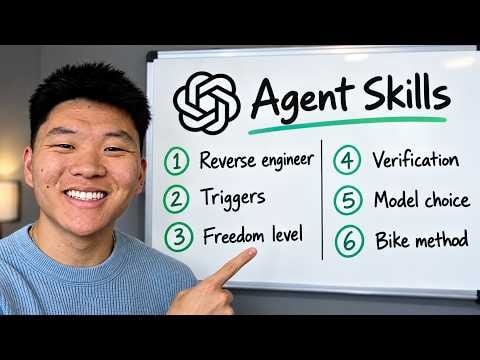
How to Build Codex Skills Better than 99% of People
Nate Herk | AI Automation19 September 2026Watch on YouTube
What you'll learn
- Codex skills are recipes that let an AI agent repeat a process the way you want it done.
- The six-step framework starts with reverse engineering strong outputs.
- Each skill gets one job and one trigger, plus a deliberately chosen freedom level.
- Building verification loops and testing cheaper models are part of constructing a skill.
- You improve the skill after every run, and the creator compares results across multiple models.
Frequently asked questions
What is a Codex skill according to the video?
Which steps make up the six-step framework in the episode?
How does the creator test the skill in the episode?
What is the Bike Method in the video?
Topics
Read next
Description from the channel
FREE First Client SOP: https://app.aiautomationsociety.ai/optin/first-client-SOP/ My playbook for growing a $1M AI agency: https://app.aiautomationsociety.ai/opaa-ads-optin My Tools💻 FREE MONTH voice to text: https://get.glaido.com/nate Code NATEHERK for 10% off VPS (annual plan): https://www.hostinger.com/vps/claude-code-hosting Codex skills are basically recipes that let your agent repeat a process the way you want it done. In this video, I break down the six-step framework I use to reverse engineer strong outputs, give each skill one job and one trigger, choose the right freedom level, build verification loops, test cheaper models, and improve the skill after every run. Then I put the process to work by running my X Article skill across Sol, Terra, and Luna and comparing the results with Astra. Sponsorship Inquiries: 📧 nate@smoothmedia.co Connect with me: https://www.linkedin.com/in/nateherkelman/ https://x.com/nateherk https://www.instagram.com/nateherk/ TIMESTAMPS 0:00 What Is a Skill? 1:55 Reverse Engineer the Output 3:42 One Job, One Trigger 6:28 Choose the Freedom Level 9:06 Build Verification Loops 12:33 Walk Down the Models 14:01 The Bike Method 15:35 Skills Inside Codex 17:08 Live Multi-Model Test 18:21 Comparing Model Results 24:12 Applying All Six Steps 26:27 Final Thoughts