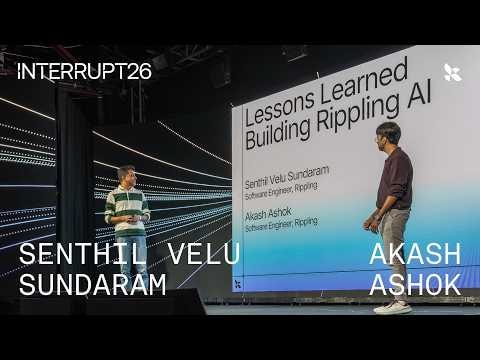
Lessons Learned Building Rippling AI | Interrupt 26
LangChain13 July 2026Watch on YouTube
Part of series
Ep. 13 · LangSmith Engine: Agents bouwen
LangChain laat zien hoe LangSmith Engine het evalueren en verbeteren van AI-agents automatiseert via trace-analyse.
View the seriesWhat you'll learn
- Rippling dropped multiple sub-agents and runs one flat agent that receives all domain context only through declarative skills and SOPs.
- One generic tool that executes SQL from just the data schema outperformed a large catalog of bespoke tools and kept data out of the context window.
- Reliable evals need repetitions: at three out of three passing runs, the lower bound of the true pass rate still sits at 44 percent.
- Rippling separates smoke evals on every commit from health evals in a pre-production stage, since of cost, uncertainty and lag you can only pick two.
- Production data with PII is synthesized into representative test data so the team does not work with real customer records.
Frequently asked questions
Why did Rippling choose one flat agent instead of multiple sub-agents?
How does Rippling prevent AI mistakes on payroll and benefits data?
How many repetitions do you need before you can trust an eval?
How does Rippling test changes before they reach production?
Topics
Read next
Snowflake over agentic analytics en de datafundering voor AI-agents
Snowflake legt in een blog uit hoe AI-agents zelfstandig bedrijfsvragen kunnen onderzoeken en hoe dat werk wordt gegrond en beheerd.
AI-agentframeworks winnen terrein nu modellen en platforms de markt rijper maken
Frameworks als LangChain, AutoGen en CrewAI worden steeds vaker ingezet voor complexe AI-workflows en multi-agentsystemen. Nieuwe modellen van Meta, Anthropic en het Chinese Meituan versterken die trend.
Arbor: AI-agents leren van eigen fouten
Microsoft Research en Renmin University of China presenteren een framework waarmee AI-agents beter software en ML-systemen kunnen optimaliseren, met betere prestaties dan Claude Code en Codex.
Vier AI-onderzoeksresultaten die modellen sneller, slimmer en zuiniger maken
Vier recente onderzoeksontwikkelingen laten zien hoe AI-modellen kleiner, sneller en beter in redeneren worden: van spaarzame activering en zelfcorrectie tijdens training tot energiezuinige inferentie en een geheugenframework voor AI-agenten.
Snowflake positioneert autonome data-engineering voor AI-agents
Snowflake beschrijft hoe autonome data-engineering, realtime analytics en operationele data samen AI-agents en -apps van actuele data moeten voorzien.
Chatgeschiedenis wissen helpt AI-agenten betere oplossingen vinden
Microsoft-onderzoekers stellen dat autonome AI-agenten vastlopen in 'idea basins' door hun groeiende chatcontext, en bereiken met hun Fork-and-Flush-methode tot 66 procent betere resultaten bij hetzelfde rekenbudget.
Sources
What is known about this topic outside the broadcast, and where it says so.
Description from the channel
Senthil Velu Sundaram and Akash Ashok from Rippling's AI team walk through the hard lessons from building and launching Rippling AI — a natural language assistant over the company's employee graph that can answer payroll, HR, and benefits questions across every system of record. They cover three major shifts: why they abandoned a multi-agent sub-agent architecture in favor of a single flat agent with declarative skills; how they replaced a large catalog of bespoke tools with LLM-generated SQL over a cached schema; and how they built an eval-driven development process modeled on statistical confidence intervals (Wilson's interval) to know exactly how many eval repetitions to run before shipping. Chapters: 0:00 The problem: an HR leader's Monday morning inbox 1:36 Demo: Rippling AI and the employee graph 2:37 Architecture overview: LangGraph, entity resolution, and the flat agent 4:54 Why the multi-agent sub-agent model failed 5:33 The flat agent: declarative skills and SOPs instead of sub-agents 6:12 Generic composable tools: one SQL-powered get-data method 7:31 The hallucination problem and why LLM-generated SQL solves it 8:14 SQL is more powerful than bespoke tools: a real example 9:38 Caching data for iterative follow-up queries 10:17 Evals first: what eval-driven development actually means 11:50 EDD is like TDD but harder: the stochasticity problem 12:37 Wilson's confidence interval: how many reps do you actually need? 13:40 The cost-uncertainty-lag triangle: you can only pick two 14:17 Smoke evals on every commit vs. health evals pre-prod 15:00 Building custom tooling and synthetic test environments in production 16:00 Three takeaways: flat agents, composable tools, evals first Resources: → LangGraph: https://www.langchain.com/langgraph → LangSmith: https://www.langchain.com/langsmith → LangChain Academy: https://academy.langchain.com