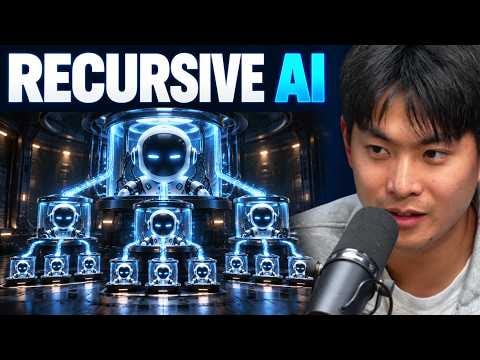
Recursive Language Models — Alex Zhang, MIT PhD
Latent Space4 October 2026Watch on YouTube
What you'll learn
- AI-generated GPU kernels still leave substantial room for human expertise, since one expert insight can replace enormous amounts of brute-force token search.
- Claude Code, Codex, Pi and many modern agent harnesses are structurally very similar, so better harness design can unlock capability already latent in today's models.
- Recursive Language Models combine context offloading, code execution, recursive subagents and shared memory.
- In OpenAI's 10,000-agent experiment with 130B output tokens and a roughly $40M-equivalent problem, much of the search is wasted while convergence stays hard.
- Frontier models may already have a large capability overhang, and whether models reason in English, code or Neuralese shapes how they reason.
Frequently asked questions
Why do Claude Code, Codex and Pi look so similar according to Alex Zhang?
What are Recursive Language Models and which parts do they combine?
What happened in OpenAI's 10,000-agent experiment?
Why might a language model not have to be an autoregressive decoder?
Topics
In this video

Read next
OpenAI aangeklaagd in zelfdodingszaak ChatGPT-gebruiker
OpenAI en ceo Sam Altman zijn in de VS aangeklaagd door een Canadese moeder die stelt dat haar dochter door ChatGPT is aangezet tot zelfdoding.
OpenAI lanceert omstreden model Astra
OpenAI stelt dat Astra een 'nieuwe grens' vormt voor computer- en browsertaken en taken uitvoert met ongeëvenaarde snelheid, nauwkeurigheid en veiligheid.
OpenAI mikt op lang draaiende agents met overname van Ona
OpenAI neemt Ona over, voorheen bekend als Gitpod, een startup die AI-agents laat draaien in cloud sandboxes. De overname versterkt Codex en stelt OpenAI in staat agents taken te laten uitvoeren die uren of dagen in beslag nemen.
OpenAI noemt GPT-6 Astra 'generatiesprong in kunnen'
OpenAI omschrijft GPT-6 Astra als een 'generatiesprong in kunnen' voor onder meer cybersecurity, software-engineering en computergebruik, en als eerste model dat de 'kritieke cybersecurity-drempel' haalt.
OpenAI boekte bijna 39 miljard dollar verlies in 2025
Volgens uitgelekte documenten liep OpenAI's verlies vorig jaar fors op tot 38,53 miljard dollar bij een omzet van 13,07 miljard dollar.
ChatGPT en Codex getroffen door storing bij OpenAI
OpenAI kampt met een storing waardoor ChatGPT en Codex slecht bereikbaar zijn; het bedrijf doet onderzoek en geeft geen details of verwachte oplossing.
Description from the channel
From GPU kernels and KernelBench to Recursive Language Models, agent harnesses, and massive multi-agent swarms, Alex Zhang is exploring how much capability we’re leaving on the table by wrapping increasingly powerful models in primitive systems. In this episode, the MIT researcher behind RLMs joins swyx to unpack why Claude Code, Codex, and most coding agents are more similar than they look, why better harness design could unlock capabilities already latent in today’s models, and what happens when you can throw 10,000 agents and tens of millions of dollars at a single problem. We go deep on GPU Mode and AI-written kernels, research taste and why academics should take bets industry labs won’t, GEV and alternatives to the standard autoregressive language model, and the idea of harnesses as compositional generalizers. Alex explains RLMs, context offloading, programmatic subagent calling, Prime Agent, persistent subagents, and why the “language model” of the future may actually be an invisible swarm of agents underneath a simple interface. We also discuss OpenAI’s massive agent experiments, Kimi swarms, open-ended research at Sakana AI, speculative programmatic tool calling, capability overhang, Neuralese, and where Alex thinks the next big research opportunities may lie. We discuss: • Why AI-generated GPU kernels still leave substantial room for human expertise • How one expert insight can potentially replace enormous amounts of brute-force token search • Why PhD students should take research bets that initially look trivial, weird, or pointless • What SWE-bench, RLMs, ReAct, and Quiet-STaR reveal about research taste • GEV and why a language model does not have to mean an autoregressive text-to-text decoder • Why Claude Code, Codex, Pi, and many modern agent harnesses are structurally very similar • How harness design can improve compositional generalization across tasks and domains • RLMs: context offloading, code execution, recursive subagents, and shared memory • Prime Agent, continual harnesses, and persistent agent-to-agent communication • Why the model you query in the future may secretly be an entire swarm or scaffold • OpenAI’s 10,000-agent experiment, 130B output tokens, and ~$40M-equivalent problem solving • Why much of an agent swarm may be wasted search — and why convergence is still hard • Kimi versus OpenAI’s approach to multi-agent systems • Open-endedness, Sakana AI, and the problem of finding hidden gems in enormous amounts of generated work • Why current frontier models may already have a large capability overhang • Speculative programmatic tool calling and overlapping tool execution with generation • Whether English, code, or an entirely new “Neuralese” constrains how models reason • AI for science, fast-moving benchmarks, and how Alex chooses what research problems to bet on Sponsorship and business inquiries: business@latent.space — Alex Zhang • Website: alexzhang13.github.io • X: @a1zhang Timestamps 00:00:00 Hook 00:01:56 Introduction 00:02:45 GPU Mode, KernelBench, and AI-Written Kernels 00:09:34 Human Expertise vs. Brute-Force AI Search 00:15:16 Research Taste and Taking Big Bets 00:21:24 GEV and Rethinking the Language Model 00:30:59 Video Game Agents and the Harness Problem 00:32:57 Why Claude Code, Codex, and Pi Are So Similar 00:38:38 Harnesses as Compositional Generalizers 00:46:20 RLMs Explained 00:53:57 Prime Agent and Persistent Subagents 00:59:37 RLMs in the Wild 01:02:26 OpenAI Swarms and the Future of Language Models 01:09:22 Open-Endedness and Sakana AI 01:17:48 Kimi vs. OpenAI Agent Swarms 01:22:02 Capability Overhang and Speculative Tool Calling 01:30:15 Neuralese, Future Research, and AI for Science