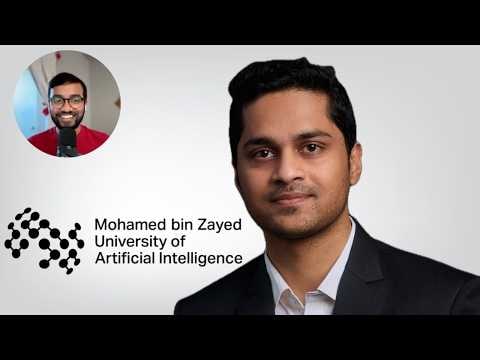
Rethinking LLMs: Why Diffusion Could Change How We Build AI
Jay Shah6 October 2026Watch on YouTube
What you'll learn
- The difference between discrete diffusion language models and traditional autoregressive LLMs for language generation.
- How blockwise diffusion addresses the latency problem of diffusion models.
- How hybrid diffusion-autoregressive models work and why they are being studied.
- How Subham Sahoo compares training costs and scaling of diffusion with autoregressive models.
- Whether diffusion can replace autoregressive LLMs and which questions remain open.
Frequently asked questions
What is the difference between diffusion language models and autoregressive LLMs according to the interview?
How does blockwise diffusion solve the latency problem of diffusion models?
How do hybrid diffusion-autoregressive models work?
Can diffusion replace autoregressive LLMs?
Topics
Read next
Vier AI-onderzoeksresultaten die modellen sneller, slimmer en zuiniger maken
Vier recente onderzoeksontwikkelingen laten zien hoe AI-modellen kleiner, sneller en beter in redeneren worden: van spaarzame activering en zelfcorrectie tijdens training tot energiezuinige inferentie en een geheugenframework voor AI-agenten.
Inconsistent gedrag van LLM's vormt risico voor multinationals
Organisaties implementeren generatieve AI voor efficiëntie, maar onvoorspelbaar gedrag van grote taalmodellen in diverse culturele en juridische contexten vormt een overlookt probleem.
Slimmer AI-gebruik in klaslokalen
Onderzoek naar manier om chatbots en LLM's op constructieve wijze in onderwijs in te zetten.
Writer voert nieuw AI-model in met lagere tokenkosten
Writer presenteert een kostenbesparing-gericht AI-model gebaseerd op Z.ai's open source GLM-5.2 voor schaalbare bedrijfsimplementatie.
PrismML wil met kleine LLM AI-gebruik veranderen
Het AI-lab PrismML richt zich op een zeer klein taalmodel dat de manier waarop AI wordt gebruikt moet veranderen.
Een startup probeert het groupthink-probleem van grote taalmodellen op te lossen
Grote taalmodellen zoals ChatGPT, Claude en Gemini vertonen een patroon van voorspelbare, gelijksoortige antwoorden. Een startup werkt aan een aanpak om die output te diversifiëren en de neiging tot eenvormigheid te verminderen.
Description from the channel
Subham Sahoo is a Research Scientist and Team Lead at the Institute of Foundation Models at MBZUAI, where he leads the Diffusion LLM team. His research focuses on discrete diffusion language models and the question of whether diffusion can offer a fundamentally different, and potentially more efficient way of generating language compared with traditional autoregressive models. Prior to that, Subham completed his Ph.D. at Cornell Tech. And his recent work includes studies of how diffusion models could be scaled and evaluated against autoregressive models. His work has helped push diffusion LMs from an interesting alternative toward a much more serious research direction for language generation. 00:00:00 Highlight & Introduction 00:02:10 Journey into AI & First Interest in Diffusion Models 00:11:37 Learning the Mathematics Behind Diffusion Models 00:16:58 Research, Publishing Pressure & Finding the Right Validation 00:20:31 How to Filter Noise from AI Research 00:23:32 Academia vs. Industry After a PhD 00:26:32 Diffusion Models vs. Autoregressive LLMs 00:29:01 How Blockwise Diffusion Solves the Latency Problem 00:30:57 Why Autoregressive LLMs Still Have Room for Improvement 00:38:00 How Hybrid Diffusion + Autoregressive Models Work 00:41:50 Can Blockwise Prediction Preserve Model Quality? 00:44:03 Will Diffusion Replace Autoregressive LLMs? 00:47:52 Does Diffusion Training Make LLMs Learn Gibberish? 00:50:45 Comparing Training Costs & Scaling 00:55:00 How Hybrid Models Scale with More Data 00:59:02 Lossy vs. Lossless Speedups 01:02:09 Are Hybrid Diffusion Models Production Ready? 01:04:54 How to Choose a Good AI Research Direction 01:08:06 Advice for Early-Career AI Researchers 01:11:39 Closing Thoughts About the Host: Jay is a Machine Learning Engineer III at PathAI working on improving AI for medical diagnosis and prognosis. Linkedin: https://www.linkedin.com/in/shahjay22/ Twitter: https://twitter.com/jaygshah22 Homepage: https://jaygshah.github.io/ for any queries. Stay tuned for upcoming webinars! ***Disclaimer: The information in this video represents the views and opinions of the speaker and does not necessarily represent the views or opinions of any institution. It does not constitute an endorsement by any Institution or its affiliates of such video content.***