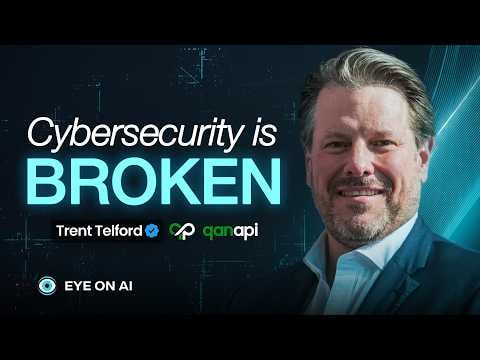
The Reason 30 Years of Cybersecurity Has Failed - and What Actually Fixes It | Trent Telford, Qanap
Eye on AI10 September 2026Watch on YouTube
What you'll learn
- Thirty years of cybersecurity fails because only the wall is protected, not the data inside, so anyone who gets through sees everything.
- AI frontier models like the Mythos class scan codebases externally and find undisclosed vulnerabilities faster to write exploits for.
- Qanapi encrypts at the data level, per word, paragraph or database cell, with unique keys tied to a verified identity and conditional policies.
- Through a gateway, enterprises can encrypt sensitive fields before data reaches public LLMs such as Claude or ChatGPT.
- Drones in contested environments need pre-loaded encrypted payloads and distributed key fragments, because wireless communication cannot be trusted.
Frequently asked questions
According to the episode, why is the 'castle wall' model of cybersecurity structurally broken?
How exactly does Qanapi's data-level encryption work?
How can enterprises still send sensitive data to public LLMs?
What does the post-quantum encryption mandate mean for companies?
Topics
In this video

Read next
De sprekers die HumanX naar Amsterdam brengen
HumanX Amsterdam opent op 22 september in de RAI met ongeveer 200 sprekers, vijf tracks en drie dagen, met oprichters van Legora, Lovable en Celonis naast enterprise-kopers van Diageo, ING en KLM.
Fortaegis haalt $50 miljoen op met de inzet dat beveiliging thuishoort in de chip, niet in de code
Vrijwel elk bedrijf dat zich voorbereidt op het quantumtijdperk doet hetzelfde: oude algoritmen vervangen door nieuwe, moeilijkere. NIST heeft de standaarden gepubliceerd, leveranciers leveren migratietrajecten, en inkoopafdelingen door heel Europa vinken de box af. Fortaegis, een Amsterdams bedrijf dat net een overtekende Series A van $50 miljoen heeft afgesloten, doet iets anders.
Euclyd haalt €200 miljoen op voor een chip die nog niemand kan kopen
Euclyd heeft nog niets op de markt. De eerste twee systemen worden in 2028 bij klanten verwacht, gevolgd door nog twee in 2029. Toch maakte het Eindhovense bedrijf op 15 september 2026 een Series A bekend van meer dan €200 miljoen, omgerekend circa $231 miljoen. Het bedrijf werd opgericht in 2024 en haalde in zijn seedronde minder dan €10 miljoen op. Investeerders kopen hier dus geen omzet.
Reaktors eerste ecosysteem-bedrijf mede-opgericht in Nederland
Reaktor Ecosystem heeft zijn eerste bedrijf in Nederland mede-opgericht: GAIA Technology Systems BV, een AI-native softwareontwikkelings-consultancy gevestigd in Amsterdam, vier maanden nadat Reaktor in mei 2026 zijn Amsterdamse hub opende.
Cybersecurity moet meegroeien met AI-integratie
Organisaties die massaal AI inzetten moeten strenge beveiligingsmaatregelen nemen om te voorkomen dat hun AI-systemen gecompromitteerd raken.
AI-security zonder fundamentele architectuurverandering haalbaar
Een technische analyse stelt dat bestaande cybersecurity-principes zonder ingrijpende architectuurveranderingen kunnen worden toegepast op AI-integratie in bedrijfsomgevingen.
Description from the channel
Every major cybersecurity breach in the last 30 years has the same root cause: the data inside the wall was never protected, only the wall. AI frontier models are now making that wall easier to breach than ever. And one company has built the fix. In this episode, Craig Smith sits down with Trent Telford, Chairman, CEO & Founder of Qanapi, to explain why the entire architecture of conventional cybersecurity is structurally broken, and what a genuinely different approach looks like. The conversation opens with a concise history of why every security innovation from SSL to firewalls to zero-trust has failed to solve the core problem: the internet was never designed to be secure, and retrofitting walls around inherently open systems only works until someone finds a way through, under, or around them. Qanapi’s approach starts from the opposite assumption - that the data will be exposed - and instead encrypts data at the individual word, paragraph, or database cell level, ties each unique encryption key to a verified identity (human, machine, or drone), and adds conditional policy layers so that even a file successfully exfiltrated by a trusted insider contains nothing readable without the exact identity and conditions being met. The conversation covers the most urgent commercial application of this architecture: enabling enterprises to safely send data to public LLMs like Claude or ChatGPT without exposing sensitive fields, solving the binary choice that has forced most large organizations to either abstain from AI or build expensive private infrastructure with far less capable models. The episode also covers drone security in battlefield environments, the post-quantum encryption mandate, and why Qanapi’s business has exploded in the last six months as enterprises finally realize that racing to adopt AI without solving the data security problem underneath it is an existential competitive risk. Key Topics Covered: ● Why 30 years of cybersecurity has failed: the internet was never designed to be secure, and every retrofit only protects the container, not the data inside it, meaning that anyone who gets through sees everything ● How AI frontier models have made the problem dramatically worse: models like the Mythos class can now scan codebases externally and discover undisclosed vulnerabilities to write exploits for, breaking the castle wall model at a new level of speed and scale ● How Qanapi’s datal-level encryption works: individual words, paragraphs, or database cells are encrypted with unique keys tied to verified identity and conditional policies, so a stolen file is a million unreadable encrypted strings ● How enterprises can now safely send data to public LLMs: Qanapi’s gateway encrypts sensitive fields before they reach Claude or ChatGPT, and the model simply reports it cannot read the encrypted sections. ● Why drone security in contested environments like Ukraine requires pre-loaded encrypted payloads and distributed key fragments, because wireless communication cannot be trusted and intercepted targeting data can be both read and poisoned ● Why the post-quantum encryption mandate is creating a multi-trillion dollar upgrade problem that most CIOs have no practical plan to execute, and how Qanapi’s API approach can retroactively encrypt legacy systems without requiring a full infrastructure replacement As enterprises face a simultaneous pressure to adopt AI for competitive survival and a growing recognition that sending proprietary data to public LLMs creates regulatory and security liability, this conversation offers the clearest and most technically specific account available of what a solution that addresses both problems at once actually looks like in practice. Subscribe to Eye on A.I. for weekly conversations with the people building and deploying the future of AI. Craig Smith on X: https://x.com/craigss EYE on A.I. on X: https://x.com/EyeOn_AI Connect with Trent Telford LinkedIn: https://www.linkedin.com/in/trent-telford Timestamps 00:00 Why traditional cybersecurity is failing 03:06 The problem with the “castle wall” approach 06:36 Assuming your data will be exposed 08:02 Encrypting data at the granular level 11:01 How identity-based encryption works 14:08 Protecting data at rest, in transit, and in use 19:01 Securing enterprise data sent to public AI models 27:09 Why AI security is exploding 32:55 Securing autonomous drones 39:31 Protecting data across AI agents 44:21 Can AI break modern cybersecurity? 47:59 The future of data security 50:10 Why foundation model companies need external security