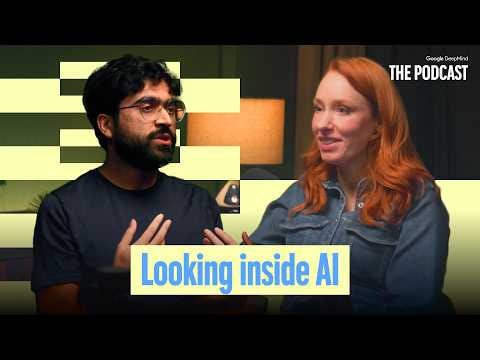
Understanding the inner thoughts of AI
Google DeepMind10 July 2026Watch on YouTube
Part of series
Ep. 7 · Prime Agent: Geheugen & Zelfcorrectie
Laat zien hoe Prime Agent via feedback-opslag en slash-refine functies zichzelf verbetert zonder handmatige hertraining.
View the seriesWhat you'll learn
- AI models don't contain fully formed thoughts, but billions of numbers forming internal representations from which patterns can be decoded
- Mechanistic interpretability seeks to understand how AI systems work by making their internal structures visible, such as sparse autoencoders
- Interpretability is essential for AI safety and alignment, as we must understand how AI makes decisions before systems become more powerful
- Researchers use techniques like chain-of-thought monitoring to track how AI reasons and identify where problems might occur
- There are inherent limits to what we can see inside AI systems, but the field is growing rapidly to make future AGI safer
Frequently asked questions
Why is understanding how AI 'thinks' important for AI safety?
What are sparse autoencoders and what do they tell us about AI?
What are the limits of examining AI systems from the inside?
Topics
In this video

Read next
Google klaagt Chinese cybercrimegroep aan voor AI-fraude
Google stelt dat een Chinese organisatie AI gebruikt voor frauduleuze activiteiten en stapt daarin samen met de FBI en Amerikaanse providers naar de rechter.
OpenAI mikt op lang draaiende agents met overname van Ona
OpenAI neemt Ona over, voorheen bekend als Gitpod, een startup die AI-agents laat draaien in cloud sandboxes. De overname versterkt Codex en stelt OpenAI in staat agents taken te laten uitvoeren die uren of dagen in beslag nemen.
Apple zou in overleg zijn met Anthropic en Google over Siri-alternatieven
Apple overlegt naar verluidt met Anthropic en Google over het beschikbaar stellen van hun AI-chatbots als alternatief voor Siri via een extensiesysteem.
Mistral haalt €3 miljard op en wordt grootste gefinancierde Europese techbedrijf ooit
Het Franse AI-lab Mistral AI sloot op 8 september 2026 een Series D-ronde van €3 miljard af, geleid door Samsung, Scaleup Europe en PSG Equity, tegen een waardering van meer dan €21 miljard. Het is de grootste aandelenfinancieringsronde die een particulier Europees technologiebedrijf ooit afsloot.
Google, Anthropic en AMD kondigen nieuwe AI-modellen en chips aan
Google presenteerde Gemini 3.5 Flash en de AI-agent Gemini Spark tijdens Google I/O 2026, Anthropic bracht Claude Sonnet 5 en Opus 5 uit, en AMD introduceerde zijn Helios AI-rack op het Advancing AI 2026-evenement in San Francisco.
Google brengt AI-weermodel WeatherNext 3 uit
Wetenschappers van Google DeepMind en Google Research hebben het AI-weermodel WeatherNext 3 uitgebracht dat het weer gedetailleerder en vaker voorspelt.
Description from the channel
What if you were to peer inside the ‘mind’ of AI? You wouldn't find fully formed thoughts, just vast arrays of numbers. In this episode, Professor Hannah Fry is joined by Neel Nanda, to shine a light on an ongoing open area of research, interpretability. Neel and his team are trying to do something phenomenally difficult: understand an intelligence that didn't come with a manual. Together, they explore the cutting-edge "neuroscience" of artificial intelligence—revealing the surprising, elegant structures being discovered inside these networks (like spare auto encoders), the inherent limits of looking under the hood, and why interpretability is absolutely essential if we are to build safe, aligned and trustworthy AI as we move towards AGI. Learn more about this area of research via https://deepmind.google/ 00:00 Introduction 02:41 Motivation for interpretability research 04:01 Mechanistic interpretability 08:14 Chain of thought monitoring 18:14 Interpretability techniques 35:00 Auditing models for safety 48:53 What comes next for interpretability Intro visuals from Winston Duke for Visualising AI: https://winstonduke.com/Google-Deepmind-Visualising-AI ___ Subscribe to our channel https://www.youtube.com/@googledeepmind Find us on X https://x.com/GoogleDeepMind Follow us on Instagram https://instagram.com/googledeepmind Add us on Linkedin https://www.linkedin.com/company/deepmind/