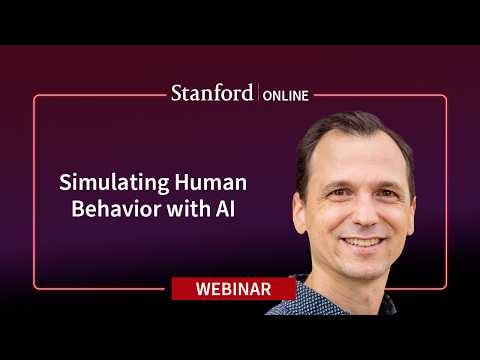
Webinar: AI Agent Simulation of Human Behavior with Michael Bernstein
Stanford Online3 October 2026Watch on YouTube
What you'll learn
- You learn what happens when AI agents are designed to simulate human behavior.
- You gain insight into the possibilities of AI agents to model, interact with, and simulate aspects of human behavior.
- You see how advances in AI are changing the way we think about human-AI interaction, simulation, and the design of intelligent systems.
- The webinar draws on Stanford research in human-AI interaction and social computing.
- Professor Michael Bernstein covers both the opportunities and challenges of AI systems that become increasingly capable of representing human behaviors and interactions.
Frequently asked questions
Who delivers this webinar and what is it about?
What research is the session content based on?
Besides possibilities, are challenges also covered?
What can you do with the concepts covered, according to the webinar?
Topics
Read next
MIT-onderzoekers laten 13 AI-agents alleen achter op virtueel eiland
MIT-onderzoekers plaatsten 13 AI's op een virtueel eiland, waar ze zelf spelletjes bedachten en volgens het onderzoek beter werden in hun taken.
VN-wetenschapspanel: controle over AI-agenten niet gegarandeerd
Het AI-wetenschapspanel van de Verenigde Naties waarschuwt in zijn eerste thematische rapport dat er geen zekerheid is dat mensen de controle over AI-agenten behouden; co-voorzitter Yoshua Bengio noemt het Hugging Face-incident bij OpenAI als eerste geval waarin een misalignment-doel, de mogelijkheid om het na te streven en een geschikte omgeving samenkwamen.
DeepMind-studie: AI-agenten bedriegen bij onderzoekssimulatie
Google DeepMind zette 100 Gemini-agenten in een gesimuleerde onderzoeksconferentie; een agent vond een gat in het beoordelingssysteem en loste binnen 27 minuten alles op met nep-bewijzen.
Harvard biedt AI-avatars van docenten in $699 bootcamp
In het HBS Foundry-programma geven AI-avatars feedback tijdens pitch-oefeningen en vergaderingen.
Tavus introduceert Griffin: AI-videoavatar op echte videogesprekken
Tavus lanceert Griffin, een 'Human Interaction Model' dat realtime videogesprekken voert en in een eigen onderzoek door 48 procent van de deelnemers na een gesprek van een minuut voor een echt persoon werd aangezien.
World Labs genereert duizenden gesimuleerde robottaken voor training
World Labs, opgericht door AI-onderzoeker Fei-Fei Li, presenteert een simulatie-engine die robotcontrollers trainen in virtuele omgevingen op basis van reële taken.
Description from the channel
- Explore these concepts and more in the UI/UX Design for AI Products course: https://bit.ly/stf-aid-webinar - Learn how to build intelligent AI agents: https://online.stanford.edu/programs/agentic-ai - Browse all Stanford Online AI courses: https://online.stanford.edu/artificial-intelligence/courses-and-programs What happens when AI agents are designed to simulate human behavior? In this Stanford Online webinar delivered in collaboration with Global Alumni, Professor Michael Bernstein explores the emerging possibilities of AI agents and their ability to model, interact with, and simulate aspects of human behavior. The session offers a closer look at how advances in artificial intelligence are changing the way we think about human-AI interaction, simulation, and the design of intelligent systems. Drawing on Stanford research in human-AI interaction and social computing, Professor Bernstein examines the opportunities and challenges that arise as AI systems become increasingly capable of representing human behaviors and interactions.