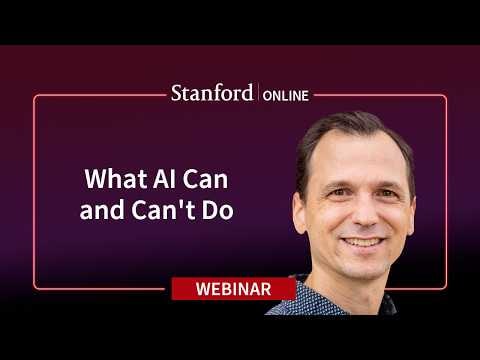
Webinar: What AI Can and Cannot Do: Intelligence Augmentation in Practice with Michael Bernstein
Stanford Online3 October 2026Watch on YouTube
What you'll learn
- You learn to distinguish problems AI can solve reliably from those that continue to require human expertise and judgment.
- You get research insights and practical frameworks for human-AI interaction to evaluate AI opportunities more thoughtfully.
- You learn how to assess potential risks in AI adoption and determine where AI genuinely augments human capabilities.
- You see the role of human oversight and judgment in an increasingly AI-enabled workplace.
- You learn how leaders and professionals can make more thoughtful choices about where AI does and does not add value.
Frequently asked questions
What is Professor Michael Bernstein's webinar about?
What do you learn in the session about evaluating AI opportunities?
Who is this webinar intended for?
Why does human oversight remain important in AI adoption?
Topics
Description from the channel
- Explore these concepts in the AI-Powered Product Innovation course: https://bit.ly/pin-stf-webinar - Learn how to build intelligent AI agents: https://online.stanford.edu/programs/agentic-ai - Browse all Stanford Online AI courses: https://online.stanford.edu/artificial-intelligence/courses-and-programs Artificial intelligence is transforming how organizations approach problem-solving, decision-making, and innovation—but knowing where AI can create reliable value is just as important as knowing where it cannot. In this Stanford Online webinar delivered in collaboration with Global Alumni, Professor Michael Bernstein explores the practical realities of AI adoption and the role of human judgment in an increasingly AI-enabled workplace. The session examines how to distinguish between problems AI can solve reliably and those that continue to require human expertise, judgment, and oversight. Drawing on research and practical frameworks for human-AI interaction, Professor Bernstein explores how leaders and professionals can evaluate AI opportunities more thoughtfully, assess potential risks, and determine where AI can genuinely augment human capabilities.