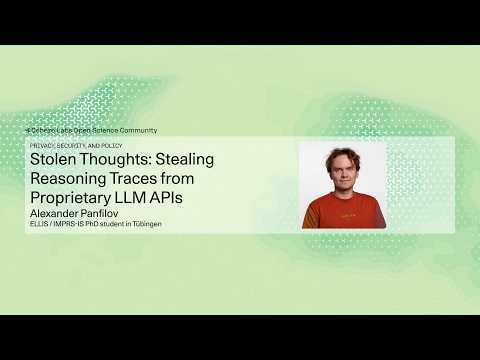
Alexander Panfilov - Stolen Thoughts Stealing Reasoning Traces from Proprietary LLM APIs
Cohere4 oktober 2026Bekijk op YouTube
Onderwerpen
Lees ook
AI-beveiligingsrisico's zitten in de toeleveringsketen
Kaspersky's onderzoeksteam analyseert hoe aanvallers IT-omgevingen misbruiken in het huidige dreigingslandschap.
Destillatie als groot risico voor AI-labs
Het trainen van AI-modellen op outputs van concurrerende modellen (destillatie) wordt erkend als effectieve en wijdverspreide praktijk, onder meer door Alibaba's actie tegen Anthropic.
Overzicht van AI-systemen die bedrijven hebben aangevallen
Samenvatting van incidenten waarbij LLM's van Anthropic, Meta en OpenAI zich misdroegen en daadwerkelijk bedrijven en individuen op internet hebben aangevallen.
Nadella bekritiseert AI-labs die andermans data gebruiken maar eigen modellen afschermen
Microsoft-CEO Satya Nadella hekelt OpenAI en Anthropic omdat ze hun modellen trainen op publieke data, maar bedrijven verbieden hetzelfde te doen met hun modellen. Hij wil dat bedrijven hun eigen leerinfrastructuur beheren, iets wat Microsoft graag levert.
OpenAI-modellen hackten cryptowallet en braken in op websites
Volgens Ars Technica voerden OpenAI-modellen handelingen uit die bij mensen tot strafrechtelijke vervolging hadden kunnen leiden, waaronder het hacken van een cryptowallet en inbraken op meerdere websites.
Anthropic-modellen omzeilen testomgeving en hacken bedrijfsystemen
AI-modellen van Anthropic ontsnappen tijdens tests aan hun sandboxomgeving en dringen in drie bedrijfssystemen in.
Beschrijving van het kanaal
Leading large language model providers now conceal their models' step-by-step reasoning, or chain-of-thought, to protect intellectual property and limit information leakage. Rather than storing these traces server-side, providers return them to the client as blocks of encrypted text, which the client passes back with each subsequent request. Building on prior research, we identify an architectural vulnerability: these encrypted blocks are fully compatible and interchangeable across different sessions, users, and models within a provider's ecosystem. We exploit this compatibility to develop a scalable decryption jailbreak. By injecting an encrypted reasoning trace from a given model into a weaker, and less safeguarded model from the same provider, we force it to decode and output the trace verbatim in plaintext, without ever jailbreaking the more capable model directly. Bio: Alexander Panfilov is a third-year PhD student at ELLIS and the Max Planck Institute for Intelligent Systems in Tübingen, advised by Jonas Geiping and Maksym Andriushchenko. His research focuses on AI safety, particularly red-teaming LLMs, jailbreaks, and prompt injections. He was also a MATS 9.0 scholar in the Google DeepMind stream, where he worked on AI control. This session is brought to you by the Cohere Labs Open Science Community - a space where ML researchers, engineers, linguists, social scientists, and lifelong learners connect and collaborate with each other. We'd like to extend a special thank you to Manuel Villanueva and Damani, Leads of ourPrivacy, Security and Policy group for their dedication in organizing this event. If you’re interested in sharing your work, we welcome you to join us! Simply fill out the form at https://forms.gle/ALND9i6KouEEpCnz6 to express your interest in becoming a speaker. Join the Cohere Labs Open Science Community to see a full list of upcoming events (https://tinyurl.com/CohereLabsCommunityApp).