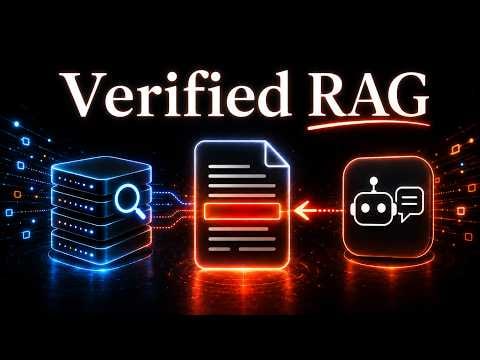
Anthropic Doesn't Trust An Agent to Both Write and Cite. You Shouldn't Either.
The AI Automators16 juni 2026Bekijk op YouTube
Onderdeel van serie
Afl. 1 · Agentic Engineering Hour
Bekijk de serieWat je leert
- Je leert welke subtiele faalwijzen AI-agenten vertonen, zoals overextensie, conflatie en citaatmismatch
- Je ziet zeven verificatiestrategieën om citaten en bronnen te controleren in agentic RAG-systemen
- Je begrijpt waarom Anthropic een aparte citaatsubagent gebruikt binnen een multi-agent onderzoeksarchitectuur
- Je ontdekt het verschil tussen evidence-first en claim-first verificatiebenaderingen
- Je leert hoe NotebookLM een eigen benadering van bronverificatie toepast
Veelgestelde vragen
Wat is overextensie bij AI-agenten?
Waarom gebruikt Anthropic een aparte citaatsubagent?
Wat is het verschil tussen evidence-first en claim-first verificatie?
Hoeveel verificatiestrategieën worden er in de video besproken?
Onderwerpen
In deze video

Lees ook
Trump wijzigt standpunt over Anthropic als veiligheidsrisico
President Trump stelt in een interview met Axios dat hij Anthropic niet langer als nationaal veiligheidsrisico beschouwt, nadat de VS het AI-bedrijf eerder dit jaar zo had bestempeld.
OpenAI mikt op lang draaiende agents met overname van Ona
OpenAI neemt Ona over, voorheen bekend als Gitpod, een startup die AI-agents laat draaien in cloud sandboxes. De overname versterkt Codex en stelt OpenAI in staat agents taken te laten uitvoeren die uren of dagen in beslag nemen.
Apple zou in overleg zijn met Anthropic en Google over Siri-alternatieven
Apple overlegt naar verluidt met Anthropic en Google over het beschikbaar stellen van hun AI-chatbots als alternatief voor Siri via een extensiesysteem.
Amazon zou overheid om blokkering Anthropic-model hebben gevraagd
Volgens berichtgeving zou Amazon de Amerikaanse overheid hebben benaderd om een Anthropic-model offline te halen, gevolgd door meldingen van kwetsbaarheden.
Claude Fable 5 en Mythos 5 geblokkeerd voor niet-Amerikanen na jailbreak-zorgen
Anthropic heeft op last van Washington de toegang tot Claude Fable 5 en Mythos 5 geblokkeerd voor gebruikers buiten de Verenigde Staten. De aanleiding is een jailbreak die volgens de Amerikaanse overheid de nationale veiligheid in gevaar brengt.
Anthropic meldt distillatiecampagnes van Chinese AI-bedrijven
Anthropic beschrijft in een nieuw rapport aanhoudende distillatieaanvallen door in China gevestigde AI-bedrijven, die de laatste maanden zouden zijn toegenomen.
Beschrijving van het kanaal
👉 Access our Starter Apps & AI Architects course in our community https://www.theaiautomators.com/?utm_source=youtube&utm_medium=video&utm_campaign=tutorial&utm_content=verified-rag 🔗 PRDs for the citations & source grounding feature (GitHub): https://github.com/theaiautomators/claude-code-agentic-rag-series 🔗 Anthropic's multi-agent research system (citation subagent architecture): https://www.anthropic.com/engineering/multi-agent-research-system 🔗 Docling (bounding-box document parsing): https://github.com/docling-project/docling 🔗 Datalab Marker: https://github.com/datalab-to/marker 🔗 Claude Dynamic Workflows: https://claude.com/blog/introducing-dynamic-workflows-in-claude-code Models keep getting better on the benchmarks, but the failure modes that matter for knowledge agents aren't going away. They're getting subtler. Beyond outright hallucination, there's overextension, where a source supports a narrow claim and the model states a broader, more confident version. There's conflation, where two retrieved chunks get fused into a single claim neither supports. And there's citation mismatch, where the cited source is real and retrieved but doesn't back the paragraph it's attached to. As models scale, these errors don't disappear. They get more confidently stated, which makes them harder to catch. Even Anthropic's own guidance tells users to review Claude's cited sources on high-stakes outputs. If you're building an AI product, you can't leave verification to chance. You have to design for it. In this video I walk through seven ways to build verification into an agentic system. The PRDs for the citation and source grounding feature shown in this video are in the GitHub repo linked above, and the full platform is available in our private community. ⏱️ Timestamps: 00:00 Intro 01:59 1. NotebookLM Approach 06:10 2. Semantic Verification 09:24 3. Anthropic's Citation Agent 11:36 4 & 5: Evidence-First & Claim-First 12:59 6 & 7: Source Verification Harnesses #AI #AIAgents #RAG #Citations #Hallucinations #VerificationLayer #KnowledgeAgents #ContextEngineering #HarnessEngineering #AIBuilder #Docling #NotebookLM #DeepResearch #AIArchitects #GroundedAI