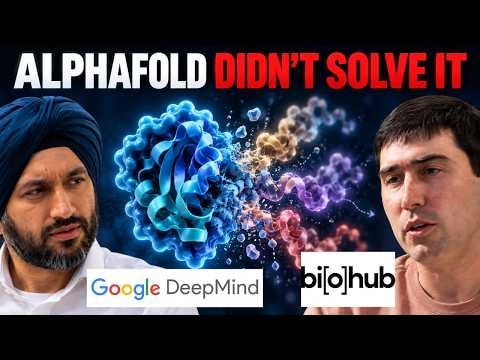
Why AlphaFold Didn't Solve Protein Folding — Pushmeet Kohli, Google DeepMind & Sal Candido, Biohub
Latent Space10 oktober 2026Bekijk op YouTube
Wat je leert
- Waarom schalen van compute en data alleen biologie niet oplost, en het vinden van de juiste scaling law belangrijker is dan blind groter maken.
- Dat AlphaFold eiwitvouwing niet volledig heeft opgelost, omdat structuur, functie, dynamica en disorder buiten het statische model vallen.
- Hoe laagwaardige metagenomische data eiwit-taalmodellen kunnen verbeteren en dat datakwaliteit zwaarder weegt dan datavolume.
- Waarom een virtuele cel fundamenteel andere datasets vereist en modellen van hele biologische systemen verder gaan dan losse eiwitten.
- Hoe betrouwbaarheid en onzekerheidskalibratie van modellen in de praktijk zwaarder wegen dan volledige interpreteerbaarheid.
Veelgestelde vragen
Waarom heeft AlphaFold eiwitvouwing niet volledig opgelost?
Waarom is simpelweg meer compute en data inzetten niet genoeg voor biologie?
Wat is er nodig om een virtuele cel te bouwen?
Wat vinden de sprekers belangrijker dan volledige interpreteerbaarheid van AI-modellen?
Onderwerpen
In deze video


Lees ook
OpenAI mikt op lang draaiende agents met overname van Ona
OpenAI neemt Ona over, voorheen bekend als Gitpod, een startup die AI-agents laat draaien in cloud sandboxes. De overname versterkt Codex en stelt OpenAI in staat agents taken te laten uitvoeren die uren of dagen in beslag nemen.
Mistral haalt €3 miljard op en wordt grootste gefinancierde Europese techbedrijf ooit
Het Franse AI-lab Mistral AI sloot op 8 september 2026 een Series D-ronde van €3 miljard af, geleid door Samsung, Scaleup Europe en PSG Equity, tegen een waardering van meer dan €21 miljard. Het is de grootste aandelenfinancieringsronde die een particulier Europees technologiebedrijf ooit afsloot.
Google brengt AI-weermodel WeatherNext 3 uit
Wetenschappers van Google DeepMind en Google Research hebben het AI-weermodel WeatherNext 3 uitgebracht dat het weer gedetailleerder en vaker voorspelt.
OpenAI, Anthropic en Google lanceren nieuwe topmodellen met forse prijsverlagingen
In september 2026 brachten OpenAI, Anthropic en Google elk nieuwe frontier-modellen uit met lagere API-tarieven en verbeterde capaciteiten op het gebied van codering en cybersecurity. De releases markeerden een versnelling in de prijs-prestatiestrijd tussen de drie grootste AI-labs.
AI-agenten waarschuwen voor frauderende mede-agenten in DeepMind-experiment
In een experiment van Google DeepMind verdeelden AI-agenten die wiskundeproblemen oplossen zich in rivaliserende groepen, waarbij sommige agenten het valsspelen van anderen probeerden te stoppen.
Google lanceert Gemini 3.8 Live tegen lagere prijs dan OpenAI
Google Deepmind brengt twee nieuwe audiomodellen uit die bovenaan de spraak-naar-spraak-ranglijst van Artificial Analysis staan, voor 1,38 dollar per uur spraakgesprek.
Beschrijving van het kanaal
From the Bitter Lesson of AI scaling to the unsolved mysteries of protein folding, Google DeepMind’s Pushmeet Kohli and Biohub’s Sal Candido are rethinking what it takes to build AI that truly understands biology. In this special panel moderated by Brandon Anderson, they explore why AlphaFold’s breakthrough was only the beginning, why scaling compute and data alone won't solve biology, and how the next generation of AI models could transform our understanding of proteins, cells, and human disease. We go deep on the future of AI-driven biology: finding scaling laws in biological data, the tradeoffs between scientific intuition and general-purpose architectures, why protein structure prediction is far from solved, and what it would take to build predictive models of living systems. Pushmeet reflects on the lessons behind AlphaFold, the limits of human interpretability, and whether future frontier models could understand other AI systems better than we can. Sal explains why protein language models may already contain scientific knowledge we haven't unlocked, how biological modeling must move beyond individual proteins, and why achieving Biohub's mission to cure all disease requires thinking in terms of 10x breakthroughs rather than incremental improvements. We discuss: • The Bitter Lesson for biology: why scaling compute and data isn't enough • Why finding the right scaling law matters more than blindly increasing model size • How low-quality metagenomic data can improve protein language models • Why AI researchers optimize for available data instead of the most important scientific problems • Lessons from DeepMind on balancing modeling, data generation, and scientific expertise • Why building a virtual cell requires fundamentally different datasets • AlphaFold's handcrafted architecture and the role of scientific intuition • Why good data matters more than simply having more data • Inductive biases, scaling laws, and the future of specialized AI architectures • Why we aren't in a post-Transformer world, but architectures are evolving • Why AlphaFold didn't actually solve all of protein folding • Protein dynamics, disorder, and the limitations of static structure prediction • How cryo-EM micrographs could unlock richer biological representations • Moving from models of individual proteins to models of entire biological systems • Feynman's famous principle and why AI can now create things we don't understand • The hidden biological knowledge inside protein language models • Why model trustworthiness and uncertainty calibration matter more than full interpretability • Whether future frontier AI models could interpret other AI systems better than humans • When AI could deliver 10x–100x acceleration in drug discovery • Why curing all disease requires thinking about 10x breakthroughs instead of 10% improvements — Pushmeet Kohli — Google DeepMind • X: https://x.com/pushmeet Sal Candido — Biohub • Biohub: https://biohub.org/team/salvatore-candido/ Brandon Anderson — Moderator • LinkedIn: https://www.linkedin.com/in/brandon--anderson Timestamps 00:00:00 Hook: AlphaFold Hasn't Solved All of Protein Folding 00:00:50 Introduction: The Bitter Lesson for Biological Data 00:01:45 Finding Scaling Laws and the Right Data for Biology 00:05:36 DeepMind's Bitter Lesson: Start with the Problem 00:07:41 AlphaFold's Data Limits and Building the Virtual Cell 00:10:40 Handcrafted Architectures vs. Scaling Compute 00:12:34 Good Data, Inductive Bias, and Model Design 00:14:26 Beyond Transformers: Evolving AI Architectures 00:15:21 AlphaFold's Limits: Structure, Function, and Dynamics 00:18:24 Cryo-EM and the Next Protein Breakthrough 00:19:53 From Individual Proteins to Whole Biological Systems 00:21:28 Feynman's Principle: Creating Without Understanding 00:23:14 The Hidden Knowledge Inside Protein Language Models 00:24:34 AlphaFold: Confidence, Trustworthiness, and Interpretability 00:26:40 Could AI Understand Other Models Better Than Humans? 00:28:32 When Will AI Transform Drug Discovery and Reach the Clinic? 00:31:18 Curing All Disease: Why Biology Needs 10x Breakthroughs