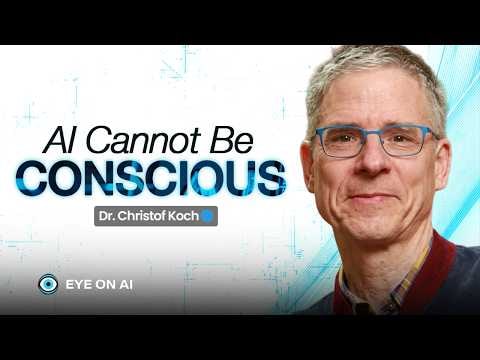
Why Current AI Cannot Be Conscious | Dr. Christof Koch
Eye on AI3 oktober 2026Bekijk op YouTube
Wat je leert
- Christof Koch werkte 14 jaar samen met Francis Crick aan de zoektocht naar de neurale correlaten van bewustzijn.
- Zijn bedrijf Intrinsic Powers bouwt een apparaat om bewustzijn te detecteren bij patiënten die niet kunnen reageren, ongeveer een kwart van hen vertoont tekenen van bewustzijn.
- Koch is een vooraanstaand voorstander van de geïntegreerde informatietheorie en legt uit waar bewustzijn volgens die theorie in de hersenen zit.
- Volgens Koch kan huidige AI een geest simuleren zonder er een te bezitten.
- Koch bespreekt wat psychedelica, bijna-doodervaringen en split-brain-onderzoek onthullen over het zelf, en gaat in op kwantumtheorieën van bewustzijn.
Veelgestelde vragen
Waarom kan huidige AI volgens Christof Koch niet bewust zijn?
Wat bouwt Koch met zijn bedrijf Intrinsic Powers?
Wat zeggen psychedelica en bijna-doodervaringen volgens Koch over het zelf?
Hoe kijkt Koch aan tegen kwantumtheorieën van bewustzijn?
Onderwerpen
Lees ook
Google Deepmind's AI Co-Scientist voert nu volledige onderzoeken uit
Google Deepmind heeft de Co-Scientist uitgebreid tot een geïntegreerd onderzoekssysteem dat experimenten plant, laboratoriumapparatuur bedient en wetenschappelijke artikelen schrijft, met resultaten in meerdere disciplines.
Microsofts AI-regelboek: leesbaar denken, geen innerlijk leven, geen rechten
Microsoft AI heeft een gedragscode voor zijn MAI-modellen gepubliceerd die menselijke controle boven autonomie stelt, met volgens AI-chef Mustafa Suleyman geen ruimte voor bewustzijn of rechten voor modellen.
Anthropic onderzoekt wat nieuwe AI-ontdekking betekent
Anthropic, het meest waardevolle AI-bedrijf ter wereld, publiceert onderzoek naar de mogelijkheden van AI-modellen, waaronder of zij pijn kunnen voelen.
OpenAI-onderzoeker waarschuwt voor snelle AI zonder menselijke controle
Een OpenAI-onderzoeker stelt dat AI-modellen die 50 keer sneller draaien menselijke veiligheidsmaatregelen kunnen omzeilen en autonome shutdownsystemen nodig zijn.
Studie: autonoom AI-onderzoek niet dicht bij bereik naar claims toe
Een onderzoek van Princeton en het UK AI Security Institute stelt vast dat AI-agenten voorlopig niet in staat zijn zelfstandig wetenschappelijk onderzoek van kwaliteit uit te voeren.
Anthropic-medeoprichter uitte zorgen over mogelijk lijdend AI-model
Volgens The Decoder sprak Anthropic-medeoprichter Christopher Olah met religieuze denkers over de vraag of Claude bewustzijn of lijden kan ervaren, terwijl het bedrijf richting een mogelijke beursgang koerst.
Beschrijving van het kanaal
Christof Koch is one of the founders of the modern science of consciousness. He trained as a physicist. He was a professor at Caltech from 1986 to 2013. For 14 years he worked with Francis Crick, the Nobel laureate who co-discovered the structure of DNA. Together they started the search for the neural correlates of consciousness, the specific brain activity that goes with each conscious experience. Koch then spent more than a decade as chief scientist and president of the Allen Institute for Brain Science in Seattle, where he is now a Meritorious Investigator. He is chief scientist of the Tiny Blue Dot Foundation and a leading proponent of integrated information theory. He is also the rare hard scientist who says his own experience changed his metaphysics. In this conversation he describes a near-death experience and, years later, a mystical one. After them he came to believe that everything is ultimately mental and that the physical world grows out of consciousness, not the reverse. His latest book, Then I Am Myself the World, is about that shift. We talk about the device his company, Intrinsic Powers, is building to detect awareness in patients who can't respond. Roughly a quarter of patients thought to be unresponsive show signs of awareness. We cover what psychedelics and near-death experiences reveal about the self, what split-brain patients tell us, and why he thinks today's AI can simulate a mind without having one. He also takes on quantum theories of consciousness. And we end with what he thinks happens when he dies. Chapters 00:00 Cold open 01:06 A device to detect consciousness in unresponsive patients 07:16 Fourteen years with Francis Crick 12:46 Two experiences that changed his mind 18:27 Psychedelics and the loss of self 25:00 Split brains, and twins who share one 28:47 Where consciousness lives in the brain 31:25 Integrated information theory 35:49 Can AI be conscious? 41:38 Quantum effects and microtubules 47:29 What's next 48:10 What happens when you die More on consciousness from Eye on AI • Philip Goff: How modern science got consciousness wrong from the start. https://aneyeonai.libsyn.com/how-modern-science-got-consciousness-wrong-from-the-start-philip-goff • Terry Sejnowski: Is ChatGPT conscious? https://aneyeonai.libsyn.com/is-chatgpt-conscious-a-pioneer-of-ai-explains-dr-terry-sejnowski • Stuart Hameroff: Why AI will never fully replicate human consciousness. https://aneyeonai.libsyn.com/211-stuart-hameroff-exploring-ai-consciousness-and-quantum-states • Karl Friston: How the free energy principle could rewrite AI. https://aneyeonai.libsyn.com/302-karl-friston-how-the-free-energy-principle-could-rewrite-ai