Why the Next AI Breakthrough May Come from Physics
The TWIML AI Podcast with Sam Charrington25 augustus 2026Bekijk op YouTube
Wat je leert
- CuspAI gebruikt generatieve AI om van nul nieuwe moleculen te ontwerpen voor CO2-afvang, waarna het ook halfgeleiders, perovskieten en batterijmaterialen oppakte.
- Machine learning-krachtvelden berekenen atoomkrachten drie tot vier ordes van grootte sneller dan kwantummechanische benaderingen zoals DFT.
- Het boek van Welling betoogt dat de wiskunde van diffusiemodellen equivalent is aan die van niet-evenwichts-thermodynamica, met kruisbestuiving in beide richtingen.
- Neurale netwerken die golven gebruiken, zoals in het brein, belanden door spontane symmetriebreking vanzelf in het optimale edge-of-chaos-regime.
Veelgestelde vragen
Wat doet CuspAI concreet?
Hoe versnelt AI materiaalonderzoek?
Waarom is fysica relevant voor de volgende generatie AI?
Onderwerpen
In deze video


Lees ook
De sprekers die HumanX naar Amsterdam brengen
HumanX Amsterdam opent op 22 september in de RAI met ongeveer 200 sprekers, vijf tracks en drie dagen, met oprichters van Legora, Lovable en Celonis naast enterprise-kopers van Diageo, ING en KLM.
CuspAI versnelt materiaalontdekking met generatieve AI
CuspAI, opgericht in 2024 vanuit Amsterdam en Cambridge, gebruikt generatieve AI om nieuwe materialen te ontwerpen die tot tien keer sneller worden gevonden dan via traditionele methoden. Het bedrijf haalde tot nu toe 130 miljoen dollar op en werkt samen met onder meer ASML, Meta en Hyundai.
CuspAI haalt $450 miljoen op en lanceert wereldwijd materiaalnetwerk
De Amsterdams-Britse deeptech-startup CuspAI sloot in juli 2026 een Series B-ronde van $450 miljoen af, geleid door Kleiner Perkins en NEA, en lanceerde tegelijk de AI Materials Foundry met meer dan 45 founding partners. De waardering van het bedrijf komt daarmee uit op $2,6 miljard.
Microsoft en Mistral sluiten miljardendeal voor AI-infrastructuur in Europa
Microsoft en het Franse AI-bedrijf Mistral breiden hun samenwerking uit met een deal van meerdere miljarden dollars, gericht op de uitbouw van AI-infrastructuur in Europa. De overeenkomst versterkt de positie van Mistral als Europees alternatief op de markt voor grote taalmodellen.
CuspAI haalt 450 miljoen dollar op en lanceert AI Materials Foundry
CuspAI, mede-opgericht door Amsterdamse AI-hoogleraar Max Welling, sloot een Series B van 450 miljoen dollar af bij een waardering van 2,6 miljard dollar en lanceerde tegelijk de AI Materials Foundry, een netwerk van meer dan 45 industriële en wetenschappelijke partners.
Vectordatabases als fundament voor AI-toepassingen
Steeds meer AI-applicaties draaien op een laag geheugeninfrastructuur die bepaalt hoe snel en accuraat een model relevante informatie terugvindt. Amsterdamse startup Weaviate bouwt aan die infrastructuur en laat zien welke productkeuzes daarbij komen kijken.
Bronnen
Wat er buiten deze uitzending over dit onderwerp bekend is, en waar dat staat.
Beschrijving van het kanaal
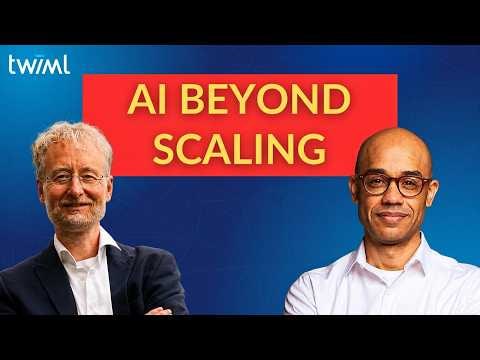
The conventional wisdom in AI is that the next breakthrough will come from more compute, more data, and larger models. But what if the next leap comes from somewhere else? In this episode, Max Welling—co-founder and CTO of CuspAI and professor at the University of Amsterdam—argues that physics may provide some of the ideas behind the next generation of AI systems. We begin with CuspAI’s work using generative AI to design entirely new materials for semiconductors, batteries, carbon capture, and clean energy. Max explains how foundation models for chemistry, agentic workflows, simulation, and automated experimentation are dramatically accelerating the search for new materials and reshaping scientific discovery. The conversation then broadens into a deeper question. Beyond giving AI new scientific problems to solve, can physics also teach us how to build better AI? Max explores surprising connections between machine learning and thermodynamics, why waves may become a new computational primitive for neural networks, and how concepts like symmetry breaking and statistical physics could inspire AI architectures beyond today’s scaling paradigm. Full show notes including references: https://twimlai.com/go/774. 🔔 Subscribe to our channel for more great content just like this: https://youtube.com/twimlai?sub_confirmation=1 📖 CHAPTERS =============================== 00:00 - Introduction 02:08 - From Equivariant Networks to AI for Science 04:55 - Founding CuspAI 07:30 - Using AI to Discover New Materials 09:03 - Designing Materials for Carbon Capture 13:20 - Partnerships and the CuspAI Business Model 14:59 - The End-to-End Materials Discovery Process 19:13 - Experiments and Self-Driving Labs 23:04 - Open-Source Molecular Dynamics on GPUs 25:23 - Foundation Models for Chemistry 30:20 - The Future of AI-Driven Materials Science 32:22 - Connecting Generative AI and Thermodynamics 39:29 - How Physics and Machine Learning Can Inform Each Other 44:53 - Waves as a New Primitive for Neural Networks 49:34 - Memory, Stability, and the Edge of Chaos 52:40 - Spontaneous Symmetry Breaking in Neural Networks 56:10 - The Two-Way Exchange Between AI and Physics 🗣️ CONNECT WITH US! =============================== Subscribe to the TWIML AI Podcast: https://twimlai.com/podcast/twimlai/ Follow us on Twitter: https://twitter.com/twimlai Follow us on LinkedIn: https://www.linkedin.com/company/twimlai/ Join our Slack Community: https://twimlai.com/community/ Subscribe to our newsletter: https://twimlai.com/newsletter/ Want to get in touch? Send us a message: https://twimlai.com/contact/