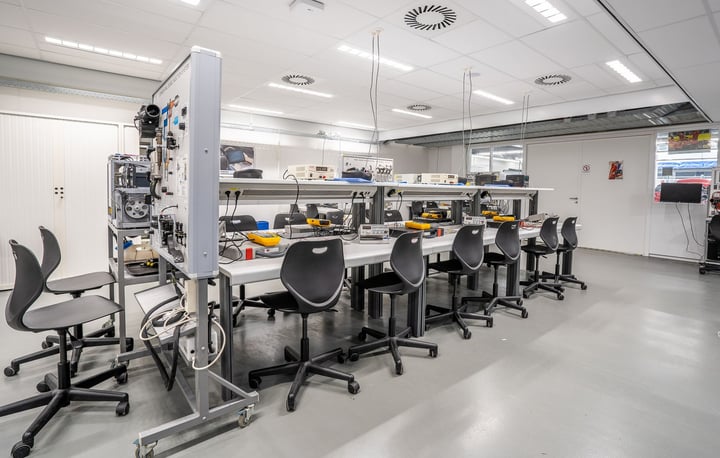
The Quantum Communication Fieldlab Rotterdam (QCFR) was officially launched in Rotterdam on 18 June. The initiative brings together five technology companies with the goal of testing, validating and deploying quantum-secure communication within existing digital infrastructure. In doing so, the fieldlab aims to go beyond earlier pilot projects and build a direct bridge to commercial and societal use.
The QCFR was established by Cisco, Eurofiber, INSPIR8ION, Q*Bird and CGI. It will have a permanent location in the Spaanse Kubus, Eurofiber's existing data centre in Rotterdam, and is housed at RDM Next. Strategic partners include the Port of Rotterdam Authority, the Municipality of Rotterdam, InnovationQuarter and the Province of Zuid-Holland.
The founders are focusing on sectors with high demands for digital security: ports, energy networks, government networks, banking and healthcare. Companies and public organisations are invited to bring their own use cases and have them tested within the fieldlab.
What each partner contributes
The division of roles within the QCFR has been clearly defined. INSPIR8ION acts as QCFR Manager and coordinates the day-to-day operations of the fieldlab. Eurofiber provides the digital infrastructure and data centre environment. Q*Bird contributes the quantum-secure communication technology, while Cisco supplies network technology suitable for use by governments and enterprises. CGI handles system integration, enabling the individual components to function as a whole.
This division of responsibilities reflects the breadth of the challenge: quantum-secure communication requires not only new cryptographic techniques, but also adjustments to network infrastructure and integration with existing systems. The fieldlab is designed to work through these steps simultaneously in a real-world environment.
Background in the Port of Rotterdam
The fieldlab builds on earlier work in the region. In February 2024, Eurofiber and partners began constructing quantum-encrypted infrastructure for the Port of Rotterdam. In May 2024, a consortium subsequently demonstrated what was described as the first scalable quantum internet connection in the port, though such claims always warrant caution regarding the precise scope of the comparison.
Those earlier projects were exploratory in nature. The QCFR is intended to make the step from demonstration to structural deployment: a permanent testing environment where technology can be continuously evaluated and further developed in collaboration with end users.
Funding and ongoing projects
Running in parallel with the launch of the fieldlab is the QUEST project, in which Eurofiber and Q*Bird are involved. This project has received €1 million in regional and European funding and focuses specifically on Quantum Key Distribution (QKD) between two Eurofiber data centres in the Randstad. QKD is a technique in which encryption keys are exchanged using quantum-mechanical principles, making eavesdropping detectable.
The funding combines regional and EU resources, which aligns with the broader European drive to strengthen digital sovereignty and cybersecurity. The QUEST project is scheduled for 2025 and is therefore running concurrently with the start-up of the fieldlab.
Growing market, but still limited adoption
The urgency behind the fieldlab is partly driven by anticipated market development. According to research cited by the initiators, the number of companies worldwide using QKD services is expected to grow from just over 1,000 in 2025 to approximately 3,000 in 2030. That increase is modest in absolute terms, but signals that the technology is gradually entering the early adoption phase.
A key driver is the so-called 'harvest now, decrypt later' threat: actors who intercept encrypted data traffic today in anticipation of decrypting it later using quantum computers. Sectors dealing with long-term secrets, such as governments and defence, therefore have an interest in making an early transition to quantum-resistant encryption.
Rotterdam as a test location for critical infrastructure
The choice of Rotterdam is no coincidence. The port is one of Europe's largest and most digitalised logistics hubs, with complex networks of sensors, control systems and communication channels. This makes the region a logical testing environment for technology that needs to function within critical infrastructure.
With the support of the Municipality of Rotterdam, the Province of Zuid-Holland and InnovationQuarter, the initiative also has a regional economic dimension. The public bodies involved see the fieldlab as a way to position the region in the emerging market for quantum technology and the associated services.
Concrete results, such as certifications, commercial contracts or tested use cases, have not yet been announced. That is understandable for an initiative that has only just launched, but the coming months will need to show whether the fieldlab can genuinely make the step from testing environment to proven deployability.