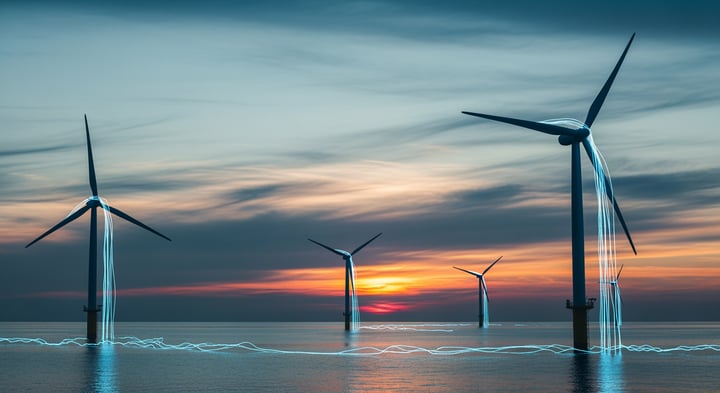
Energy company Vattenfall, Amsterdam-based deeptech startup Project Enki and automation company ABB are jointly investigating whether it is feasible to build AI data centres directly on offshore wind farms. The announcement was made on 18 and 19 June 2026. The initiative is at an early strategic stage: the parties are looking for a suitable first project site, but no specific locations have yet been identified.
The core of the concept is that the data centres adjust their computing capacity to the amount of wind energy available. When wind supply is high, the systems run at full capacity; when wind is lower, AI computations can be deferred or slowed down. This distinguishes the model from traditional data centres, which require a constant power supply.
Project Enki is targeting a capacity of 20 to 25 megawatts per data centre. The installations would use only a limited share of a wind farm's total capacity, leaving the remainder of the generated electricity available for the regular power grid.
Grid congestion as the driving force
Grid congestion is a persistent problem in the Netherlands. At times when wind farms are producing large amounts of electricity, the onshore grid is sometimes unable to absorb all that energy. In some cases, wind turbines are deliberately shut down as a result, a practice known as curtailment. By connecting a data centre directly to a wind farm, that surplus power can still be put to productive use for AI computations.
Nardi Polak, Head of Supplier Innovation at Vattenfall, sees this model as a way to increase the value of wind farms without placing additional pressure on the grid. The idea is not to bypass the grid, but to capture the production peaks that would otherwise be lost or lead to congestion.
Existing platforms as a foundation
Project Enki does not intend to build the data centres on entirely new offshore structures, but rather on existing, unused platforms at sea, such as former oil and gas platforms. This could significantly simplify construction and reduce costs, although exact cost estimates have not yet been published. Financing details have also not been disclosed; for the time being, this remains an exploratory feasibility study.
Paul Kunneman, Chief Executive of Project Enki, emphasises that the location does not necessarily have to be in Dutch waters. Vattenfall has wind farms in the North Sea, but the consortium does not rule out other locations. A definitive choice will follow later in the process.
Cooling with seawater
A practical advantage of an offshore location is the availability of seawater for cooling. Data centres generate significant heat and typically require intensive cooling systems. Using seawater is more efficient than air cooling and eliminates the need for fresh water consumption, an increasingly relevant consideration on land.
The combination of a direct connection to a wind farm and seawater as a cooling medium makes the offshore approach more attractive than a comparable onshore setup, according to the parties involved, where both grid connection and water consumption more frequently present bottlenecks.
Focus on demanding AI workloads
The data centres are explicitly not intended for traditional cloud services, but for heavy AI workloads such as training large language models. This type of computation is particularly well suited to an intermittent power supply: training processes can in principle be paused and resumed without the final results being affected, unlike real-time applications that require a stable connection.
Whether and when a first project will get off the ground remains unclear. The consortium has not yet published a timeline. The next step is to identify a concrete project site, after which a further feasibility analysis can follow.