Investing in Dutch AI
From 8 to 81, the government makes significant strides in AI
Dec 4, 2025

In June 2024, TNO counted eight GenAI applications within the Dutch government. A year later, there are 81. This is no longer cautious experimentation. Nearly half are now operational in daily practice, ranging from chatbots that assist civil servants to tools that make text accessible for those with low literacy. The government is moving, and quickly too. But with this speed also come questions. Where is it going well, where are the challenges, and who is actually providing all this technology?
What the government does with AI
Municipalities are leading with 34 applications, over 40% of the total. That makes sense. There are 342 municipalities in the Netherlands, all with similar services. A chatbot that works in Utrecht can in principle also work in Eindhoven.
But there is a noticeable pattern here. Of all applications, 78% is aimed at employees. Chatbots that help with summarizing documents, answering internal questions, processing knowledge. Only 17% is directly focused on the citizen [1].
This choice is deliberate. By first deploying AI internally, the government gains experience without direct risk to citizens. Organizations increasingly offer employees their own chatbot to prevent uncontrolled use of ChatGPT. Sensible, but it also means that citizens will notice little of the AI investments for now.
What is going well is collaboration. GEM, the partnership of 25 municipalities, is developing a joint chatbot. Open source, public money hence publicly available. And more and more organizations are focusing on the societal challenge rather than the technology.
Where it becomes tricky is that for more than half of the applications, the risk classification is still unknown [1]. And data management is often not in order. "If we put the chatbot on our website, all web pages must be up-to-date, otherwise the bot will say crazy things," according to a respondent [1].
But who actually provides this?
Microsoft, Google, and OpenAI provide good technology. Proven, documented, ready to use. For a municipality that wants to start tomorrow, the choice is understandable. The models work, the contracts are often already in place, the IT department knows the environment.
But a respondent from the TNO study expresses it sharply. "In my experience with the Dutch government, we have walked into the Microsoft trap. Now you notice that we are again at a kind of crossroads." [1]
The figures confirm that picture. For 54% of the applications, we know for sure that they run on American technology. The origin of 42% is unknown. Only 4% is demonstrably European [1]. OpenAI, Meta, Microsoft, Google dominate. The European alternatives can be counted on one hand, namely DeepL and Mistral. And respondents indicate that these European options are not yet up to standard [1]. That is partly true. But quality grows with use. Without customers, alternatives will lag behind.
Why this matters
The question is not whether Big Tech delivers good tools. They do. The question is whether we want to entrust everything to them. In the current geopolitical climate, this is more than a technical choice.
Every euro that goes to Silicon Valley is money not going to Dutch AI companies. No revenue, no growth, no track record to win the next tender.
The Netherlands has the ambition to position AI and data as the third mainport, alongside Schiphol and the Rotterdam port [2]. That ambition requires launching customers. Large clients who dare to choose Dutch and European solutions, even if they are not yet perfect. The government can take on that role.
But then procurement must cooperate. Regular ICT tenders leave little room for innovative SMEs [3]. Requirements around revenue, track record, and certifications present barriers that young companies can rarely overcome. A chicken-and-egg problem that the government itself can solve.
Where it can be different
There are examples of organizations that make a deliberate choice to do things differently. The National Archives is developing an Archive Assistant on Mistral, a French open-source model [1]. A principled choice to maintain control over technology.
Tolkie, a social enterprise from Eindhoven, helps municipalities make their texts accessible to the 3.3 million low-literate people in the Netherlands [4]. The tool runs on European servers. Several municipalities are already using it. It shows that Dutch startups can deliver what the government needs.
A respondent summarizes it. "Only civil servants won’t manage. Only entrepreneurs won’t manage. You really have to move forward together." [1]
The crossroads
From 8 to 81 applications in a year. The government is no longer experimenting but building. Municipalities are collaborating, organizations are sharing knowledge, and increasingly the societal challenge is central rather than technology.
The examples in this article show that Dutch and European alternatives exist. The National Archives deliberately chooses Mistral, Tolkie helps municipalities with accessible texts. The growth from 8 to 81 is a promising first step. The next is for the Dutch startup industry to offer more homegrown services, with the government as a launching customer. This way, our ecosystem can take off, and we accelerate the ambition to become the AI and data mainport of Europe.
References
[1] TNO (2025). Government-Wide Monitor Generative AI. https://www.tno.nl/nl/newsroom/2025/12/stijging-gebruik-generatieve-ai-overheid/
[2] Government of the Netherlands (2024). Dutch Digitalization Strategy. https://www.rijksoverheid.nl/onderwerpen/digitalisering
[3] Digital Government (2024). Innovation with AI. https://www.digitaleoverheid.nl/overzicht-van-alle-onderwerpen/nieuwe-technologieen-data-en-ethiek/artificiele-intelligentie-ai/innovatie-met-ai/
[4] Tolkie (2025). Tolkie Reading Aid. https://tolkie.nl/
Read More


Join
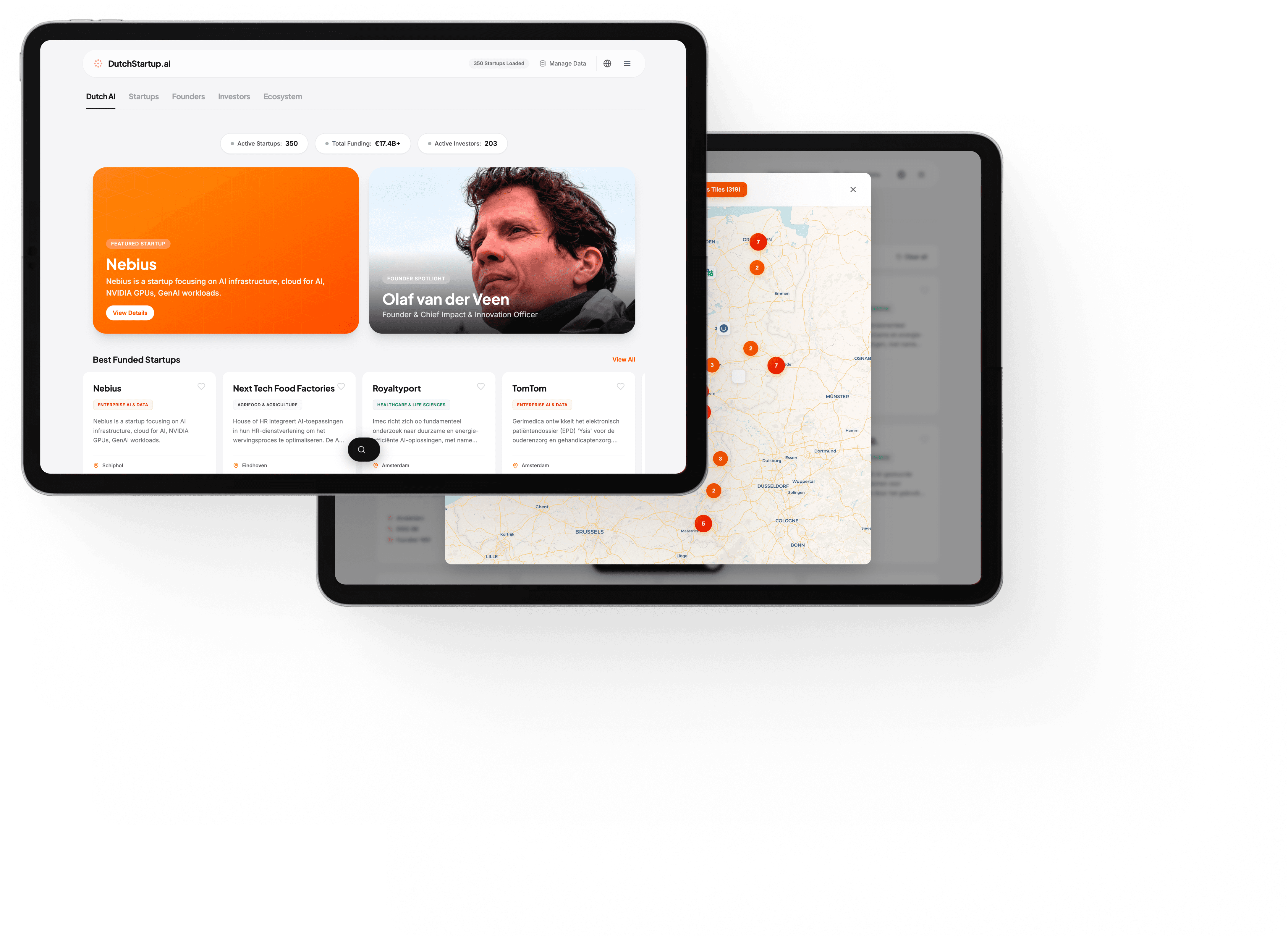
DutchStartup.AI
Secure your place in the Dutch AI ecosystem now
Founding Partner

Powered by

Join
DutchStartup.AI
Secure your place in the Dutch AI ecosystem now
Founding Partner
Powered by
Join
DutchStartup.AI
Secure your place in the Dutch AI ecosystem now
Founding Partner
Powered by
Dutch AI
Built Different
An initiative by Willem Blom & Max Pinas | Powered by Studio Hyra
Dutch AI. Built Different 2025
Dutch AI
Built Different
An initiative by Willem Blom & Max Pinas
Powered by Studio Hyra
Dutch AI. Built Different 2025
Dutch AI
Built Different
An initiative by Willem Blom & Max Pinas | Powered by Studio Hyra
Dutch AI. Built Different 2025