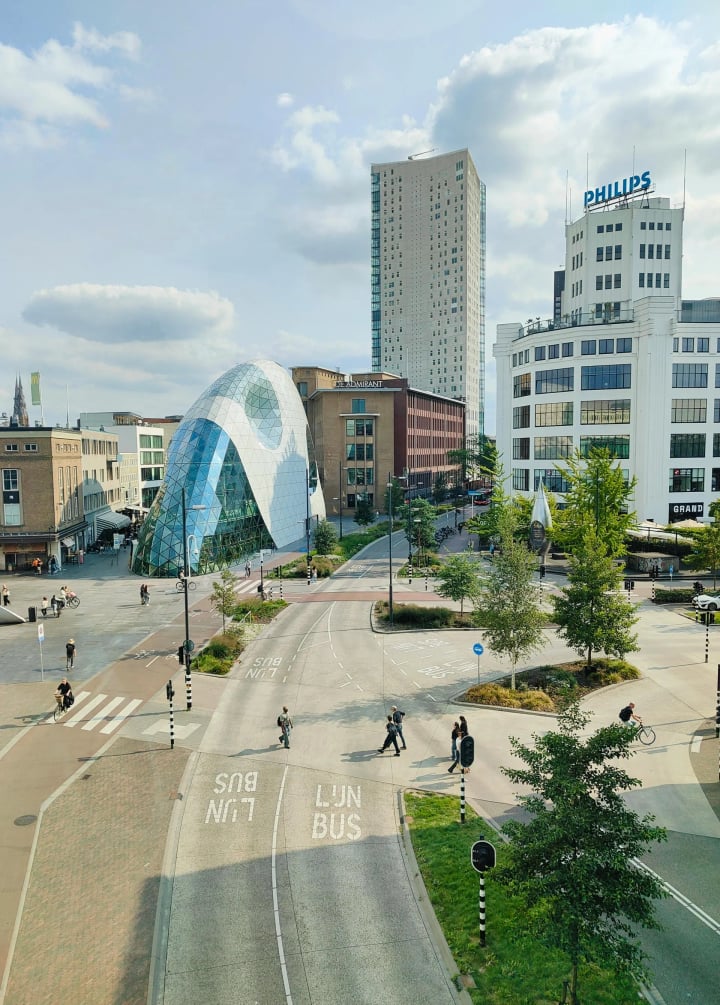
The conventional answer is to build more. Larger server farms, more capacity, more cooling. But on the High Tech Campus in Eindhoven, a team of two hundred people is working on a fundamentally different approach. Axelera AI moves intelligence from the cloud to the point where data is actually generated, in cameras, robots, cars, and medical devices. They call it the edge.
An Italian who learns to build chips
Fabrizio Del Maffeo is an engineer, Italian, and lives in the Netherlands. He spent years at the ASUS computing group, selling and developing IoT hardware. There he noticed something he couldn't let go of. Customers were increasingly asking for devices that could think for themselves, without a constant connection to a data centre. But the chips he could supply were not designed for that.
"Honestly, I had no idea how to solve it, because I had always been buying computing hardware," Del Maffeo said in a podcast. [3] It took him two years to assemble a team, scientists from IBM Research in Zurich, imec in Belgium, and ETH Zurich. In July 2021, Axelera AI was founded. Three years later, the company had raised more than 200 million euros and was shipping chips to customers in fifteen countries. [4]
The wall where data hits a dead end
The technical breakthrough lies in a concept that sounds like a contradiction: in-memory computing. In traditional chips, calculations are performed in one place while data is stored in another. That means constant traffic between processor and memory, movement that costs time and energy. In the chip industry, this is known as the memory wall, the invisible barrier where performance stalls.
Axelera's approach is different. Their chips perform calculations where the data already resides. No endless shuttling back and forth. The result, according to the company, is a chip that is up to ten times more energy-efficient than the competition, at a fraction of the cost. [5]
"You can't imagine a car driving through a tunnel, unable to connect to the cloud, yet still needing to make a decision. You need intelligence that runs without connectivity.", Fabrizio Del Maffeo [3]
A billion cameras that can become smart
The go-to-market strategy is pragmatic. There are more than one billion security cameras installed worldwide. You don't simply replace them. But you can place a smart box alongside them, a unit with an Axelera chip that analyses footage locally and only forwards relevant information. They call it retrofit.
Del Maffeo sees applications everywhere. Cameras in shops that not only monitor but also analyse which products customers are looking at. Medical devices that carry out preventive checks at a GP's practice rather than in a hospital. Robots that have a brain inside their own body, not somewhere in a data centre hundreds of kilometres away.
"The next big wave is AI at the edge, in the physical world. We believe that as technology matures, it tends to decentralise.", Fabrizio Del Maffeo [3]
The question everyone is asking
At the Supercomputing conference in 2024, one question hung in the air: is there an alternative to Nvidia? The American company dominates the market for AI chips, particularly for training models. But Axelera targets a different segment. Inference, running trained models, requires different hardware: less raw power, more efficiency.
Validation came from an unexpected direction. In March 2025, Axelera received 61.6 million euros from the EuroHPC Joint Undertaking for the development of Titania, a chiplet platform for high-performance computing. [6] The grant fits into a broader European push for digital sovereignty. RISC-V, the open-source architecture Axelera uses, reduces the continent's dependence on American and Chinese chip giants.
The choice of Eindhoven is no coincidence. ASML is just around the corner. Philips has its roots there. The entire ecosystem of suppliers, knowledge institutions, and talent is within reach. Axelera is not building in Silicon Valley. They are building where the lithography machines that underpin the entire chip industry come from.
A lesson in infrastructure
For the Dutch AI scene, there is a lesson in this story. Not every breakthrough sits in the application layer, in the chatbots and generative tools that make the headlines. Sometimes the greatest opportunity lies in the infrastructure beneath: the chips, the hardware, the foundations on which everything runs.
Axelera also demonstrates that EU funding can support serious growth. More than 60 million euros for a single project is no trivial matter. And it proves that deep tech is possible in the Netherlands, provided you find the right partners and have the patience to spend two years building a team before producing a single chip.
The remaining question is whether Europe can scale fast enough. Chip manufacturing requires astronomical sums. Nvidia invests billions per quarter. But in a world where the power grid is full and data centres are running up against limits, efficiency suddenly has strategic value. And that is precisely the bet Axelera is making.